Driven by both Industry 4.0 and digital agriculture, NPK fertilizer production lines are accelerating their transformation towards intelligence and flexibility. Traditional operation modes relying on manual experience are gradually being replaced by data-driven intelligent systems.
Currently, advanced NPK fertilizer production lines commonly integrate DCS or PLC control systems, achieving full-process automation from raw material warehousing to finished product delivery. For example, intelligent batching systems can automatically retrieve the optimal NPK ratio based on soil test reports or customer orders, dynamically adjusting the feeding rate of each raw material with an accuracy of ±0.3%. The granulation and drying stages utilize real-time feedback from sensors for temperature, humidity, and current, with AI algorithms automatically optimizing parameters to avoid over-drying or under-drying, resulting in annual energy savings of 8%–12%.
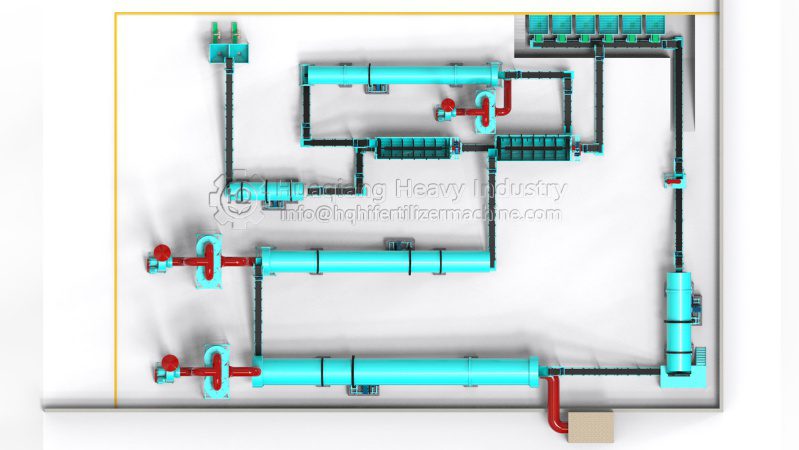
More cutting-edge applications include digital twin technology – creating a mirror model of the production line in a virtual space for simulation, debugging, fault prediction, and capacity optimization. Meanwhile, MES (Manufacturing Execution System) connects ERP with workshop equipment, enabling integrated management of production planning, quality traceability, and energy consumption analysis. Each bag of fertilizer can have a QR code, allowing users to scan and view information such as raw material source, production batch, and nutrient content, enhancing brand transparency.
Furthermore, remote maintenance platforms allow engineers to diagnose equipment status online, providing early warnings for issues such as bearing wear and motor overload, reducing unplanned downtime. Under the guidance of the “fertilizer reduction and efficiency improvement” policy, intelligent technology also supports the development of high-value-added products such as specialized fertilizers and slow-release fertilizers, meeting the precise needs of economic crops such as orchards and tea plantations.
In the future, with the popularization of 5G, edge computing, and IoT technologies, NPK fertilizer production lines will become more efficient, flexible, and environmentally friendly, becoming an important link in the smart agricultural supply chain.