The core advantages of the double shaft paddle mixer lie in its ability to achieve uniform mixing, eliminate dead zones, and provide controllable mixing intensity. It is optimally suited for mixing processes that require high-efficiency blending, the dispersion of agglomerates, or the multi-component conditioning of materials.
It is particularly well-suited for mixing high-moisture, viscous materials—such as composted livestock and poultry manure, sewage sludge, and residues from traditional Chinese medicine production. Given that these materials are characterized by high moisture content and a tendency to agglomerate or adhere to container walls, the mixer’s twin, counter-rotating, and staggered paddles generate powerful shear forces. This action rapidly breaks down clumps and prevents wall adhesion while simultaneously ensuring uniform blending, thereby perfectly meeting the pretreatment requirements for organic fertilizer raw materials.
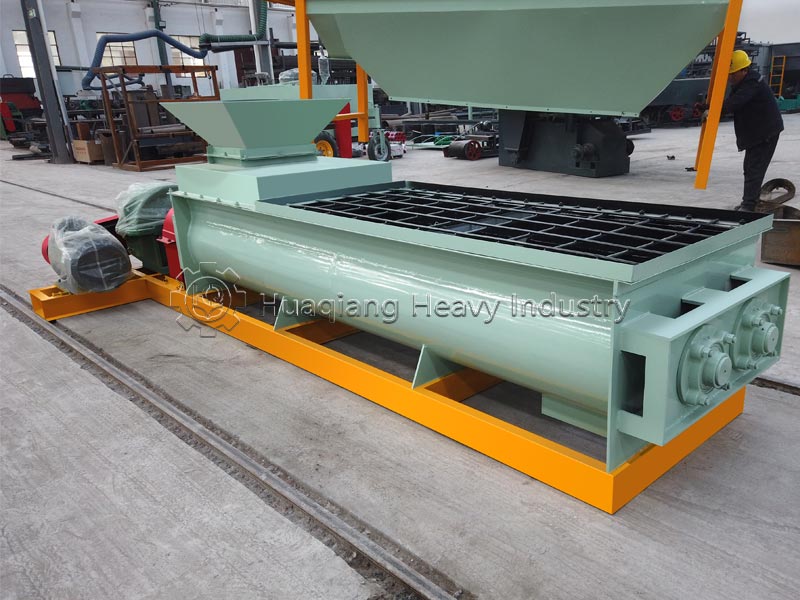
Secondly, it is highly effective for multi-component mixing and conditioning processes. For applications such as blending raw materials for compound fertilizers or bio-fertilizers—where various nutrients and auxiliary agents must be combined in precise proportions and their moisture and viscosity adjusted—the double axis paddle mixer offers both high efficiency and high precision. It ensures the uniform distribution of components, prevents nutrient segregation, and simultaneously facilitates the necessary humidification and conditioning of the mixture.
Furthermore, the mixer is suitable for processing lumpy materials containing minor impurities. Such materials require no complex pretreatment; the twin-shaft paddles can directly break down impurities and complete the mixing process in a single step, thereby reducing upstream processing stages and significantly boosting overall processing efficiency.
In summary, the double axis paddle mixer is the optimal choice for mixing high-moisture viscous materials, multi-component mixtures requiring conditioning, and materials containing minor lumpy impurities. Its specific characteristics allow it to precisely align with diverse processing requirements, delivering highly efficient and uniform mixing results.