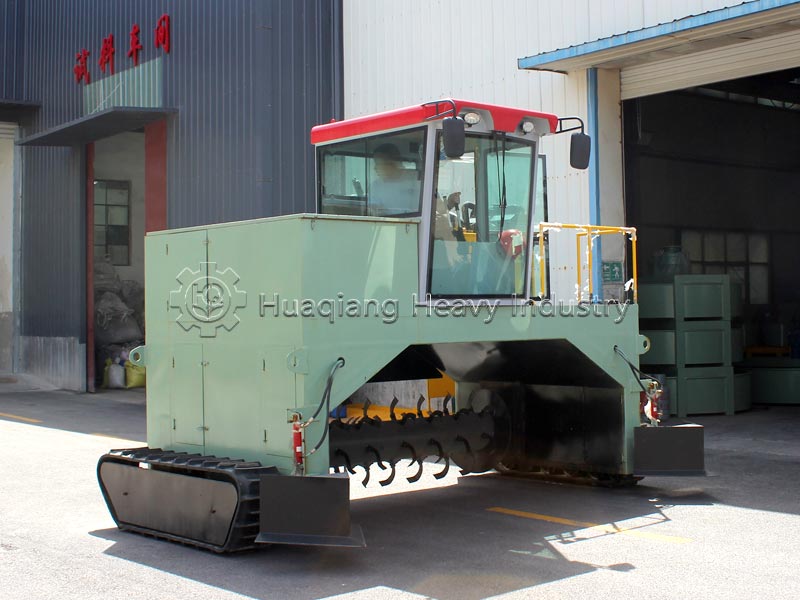
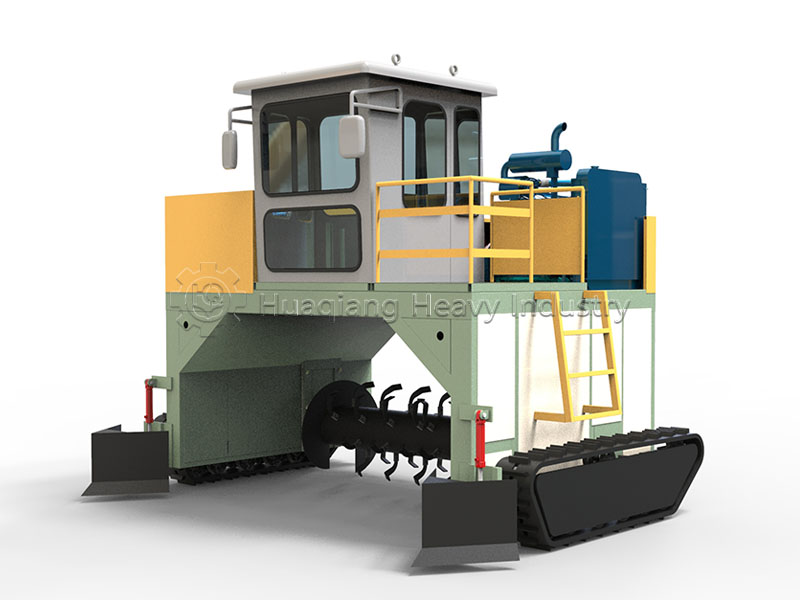
The windrow compost turning machine is a mature and widely used self-propelled piece of equipment for organic fertilizer windrow composting. Powered by a diesel engine and utilizing a crawler undercarriage combined with a transverse turning drum, it straddles the windrow to complete the turning process in a single pass. Its self-powered nature—requiring no external power supply—makes it particularly suitable for use in open fields far from power infrastructure and at temporary composting sites. In projects such as manure treatment at small-to-medium-sized livestock farms, township-level organic fertilizer processing, and centralized agricultural waste composting, the windrow compost turning machine has become the primary turning equipment for aerobic windrow fermentation processes, thanks to its site adaptability, high operational efficiency, and ease of operation and maintenance.
Raw material blending and windrow formation. Livestock and poultry manure are thoroughly mixed with bulking agents—such as crushed straw or rice husks—to meet specific carbon-to-nitrogen (C/N) ratio and moisture content requirements. The mixture is then piled on the ground into long windrows with a trapezoidal cross-section. Windrow height and width are determined by the turner’s specifications, while the length is flexibly set based on site conditions. During formation, care is taken to ensure the windrow is uniform in shape and straight in alignment to facilitate the equipment’s straddling operation.
Mechanical turning and oxygen supply. After the windrow is formed, aerobic microorganisms within the material multiply rapidly, causing the internal temperature to rise above 50°C within 48 hours. At this point, the crawler-type compost turning machine straddles one end of the windrow to begin operations; the diesel engine drives the tracks forward along the windrow, while the turning drum scoops up the material from the base and throws it backward. As the material makes full contact with the air in mid-air before landing back on the pile, the windrow shifts backward, and the material is redistributed—mixing top and bottom, inside and outside. This turning action simultaneously performs four functions: oxygen supply, material loosening, homogenization, and moisture evaporation.
The process cycle consists of two stages: the high-temperature phase and the maturation phase. The high-temperature phase lasts 7 to 10 days, with turning performed once daily; the internal temperature is maintained between 50°C and 70°C, effectively inactivating pathogens, parasite eggs, and weed seeds. During the maturation phase, the temperature gradually decreases, and the turning frequency is reduced to once every two to three days; the material undergoes further organic matter degradation and stabilization through low-intensity turning. The entire process, from windrow formation to the completion of maturation, takes approximately 15 to 20 days.
Material discharge and site turnover. Once matured, the material is cleared from the end of the windrow and processed via crushing and screening for use as organic fertilizer feedstock. The vacated site is then used to form new windrows for the next fermentation cycle, allowing for a rolling, continuous operation across multiple windrows on the same site.
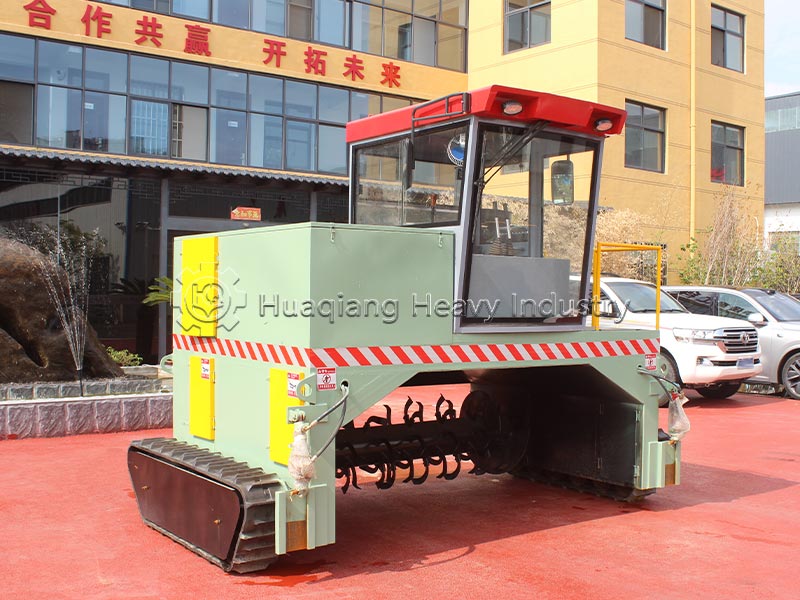
Low site requirements and minimal civil engineering investment. Windrow fermentation does not require the construction of concrete fermentation tanks or the laying of travel rails; simply leveling and compacting the ground makes the site ready for use. Existing spaces—such as unused corners of livestock farms or fallow fields after harvest—can be utilized, resulting in civil engineering costs far lower than those of tank-based fermentation systems.
Self-powered and highly maneuverable. The diesel power system is completely independent and not restricted by power grid coverage, allowing the composting site to be selected based on the concentration of raw materials. The equipment can move autonomously between different composting locations; a single machine can service multiple windrows or even multiple sites, ensuring high equipment utilization efficiency.
Thorough turning and uniform fermentation. The straddle-type drum turns and aerates the entire windrow from bottom to top, ensuring full exchange between material layers and eliminating fermentation “dead zones” or anaerobic pockets. When the material is thrown into the air, it has a large surface area for contact with air and receives ample oxygen; this maintains stable high temperatures and ensures consistent fermentation progress. The tearing action of the drum’s turning tines effectively breaks up clumps and long-fiber materials, promoting material homogenization.
High processing capacity and low labor requirements. The drum’s turning width covers the entire width of the windrow, completing the turning process in a single pass for high operational efficiency. A single operator can manage the entire turning process; the machine moves automatically without manual pushing or pulling, and the stable diesel power allows for continuous operation over several hours, making it suitable for high-volume production tasks.
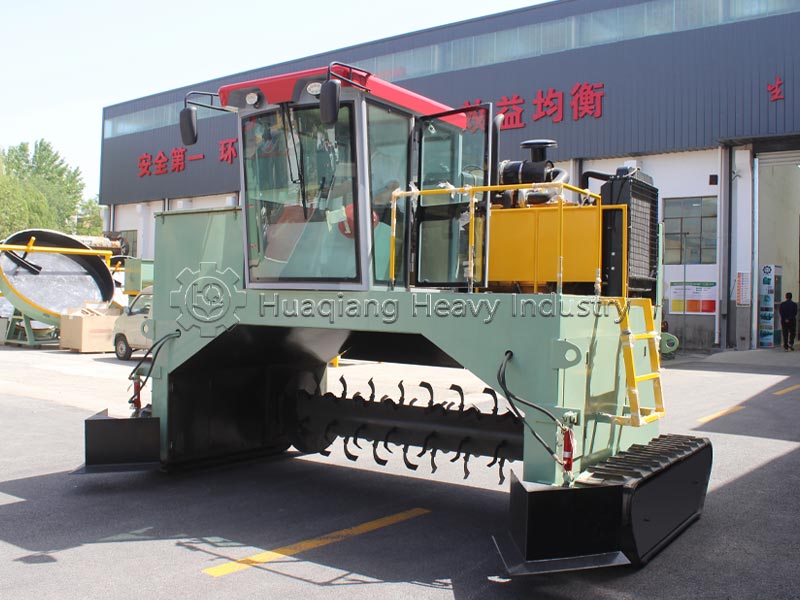
Within the overall layout of an organic fertilizer production line. The fermentation site can be located in an open-air or covered area with good ventilation and proximity to raw material sources; decomposed material is then transported short distances to the processing workshop using forklifts or loaders. This layout reduces infrastructure investment for the fermentation zone and prevents moisture and odors generated during fermentation from affecting equipment in the processing workshop.
Within the fermentation section, a windrow compost turner handles all turning operations, with a single machine capable of managing multiple parallel windrows. Windrow formation and material discharge are staggered by batch or day, and the machine follows a fixed daily route to turn the windrows sequentially, creating a streamlined, continuous workflow.
In small-to-medium-sized organic fertilizer production lines, the windrow compost turner is sometimes the only large piece of equipment. Subsequent crushing uses small-scale crushers, screening employs simple rotary screens, and granulation utilizes either flat die or disc granulators depending on the product positioning; this keeps both total investment and operating costs low.