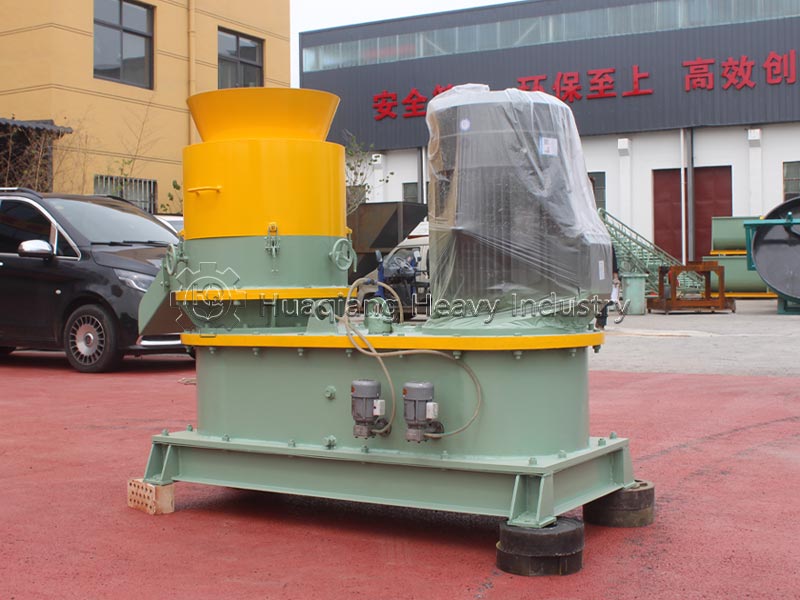
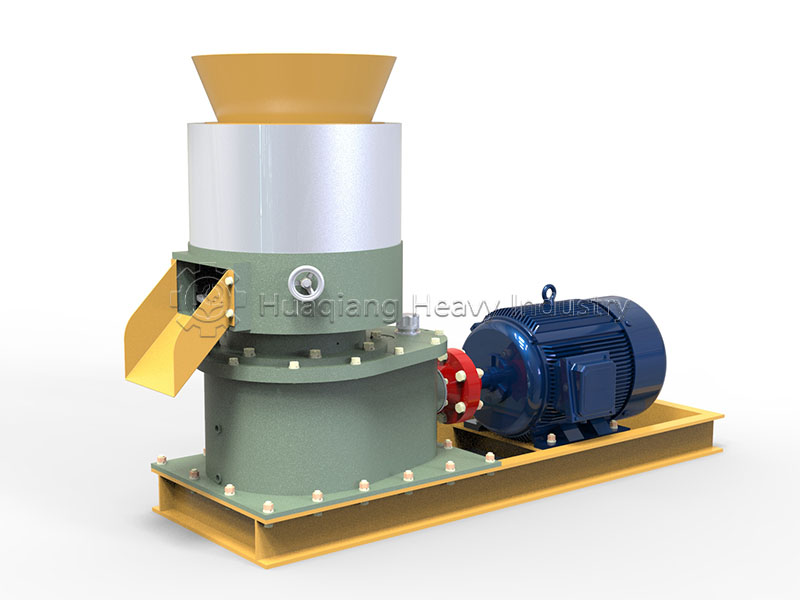
The flat die pelleting machine is a mature and widely used extrusion-type granulation machine in the organic fertilizer processing industry. In organic fertilizer production, the granulation stage often poses the greatest challenge to equipment adaptability due to the high fiber content, fluctuating moisture levels, and inconsistent impurity content of organic materials. The flat die pelleting machine has established a strong foothold in this field thanks to its stability and resilience in the face of these demanding conditions. For users who wish to produce organic fertilizer in a marketable granular form without investing excessive effort in equipment operation and maintenance, the flat die pelleting machine—proven through extensive production practice—is a reliable choice.
Raw material fermentation and pretreatment. Livestock and poultry manure undergo composting and fermentation to ensure full decomposition; this process kills pathogens and weed seeds, eliminates odors, and stabilizes material properties. The moisture content of the fermented material naturally drops to 30%–38%, which is the optimal range for feeding into the flat die pelleting machine. The material undergoes preliminary crushing to break up large clumps and long fibers, and hard impurities (such as stones) are screened out before the material enters the feed hopper.
Forced feeding stage. A screw auger equipped with an anti-bridging device is installed at the bottom of the feed hopper to force the material into the granulation chamber. The rotational speeds of the auger and the main die plate are interlocked and regulated via a variable frequency drive to ensure the feed rate matches the granulation speed, preventing the granulation chamber from running empty or becoming overloaded.
Compression and extrusion stage. Material falls onto the rotating circular die plate and is drawn into the gap between the die and the pressure rollers. Under the powerful pressure of the rollers, the material is compacted and forced into the die holes; after undergoing a brief compression and shaping process within the holes, it is continuously extruded from the underside of the die plate in the form of cylindrical strands.
Cutting and collection stage. A cutter mounted beneath the die plate cuts the continuous extruded strands to a preset length, and the resulting granules fall into a collection hopper or onto a discharge conveyor belt.
Post-processing stage. The extruded granules still have a moisture content of approximately 30%; they must be dried—either mechanically or through natural air-drying—to reduce the moisture content below 20% before packaging and storage. If functional microbial agents are to be added, they should be applied via spraying or mixing after the granules have cooled to prevent heat-induced inactivation.
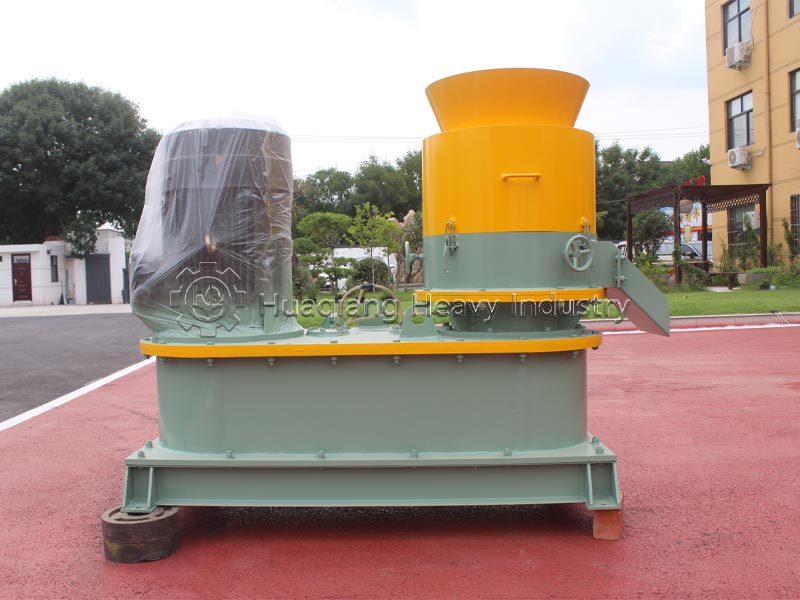
High tolerance for moisture content. Fermented organic materials with moisture levels between 25% and 38% can be successfully granulated; this range encompasses the natural moisture state of most fermented organic materials. The flat-die process eliminates the need for pre-granulation moisture adjustment, simplifying the workflow and reducing material pre-treatment costs.
Ambient-temperature processing preserves material activity. The temperature rise during extrusion typically does not exceed 30°C, resulting in negligible thermal damage to residual organic matter and added functional microbial agents. Granules produced via the flat-die method excel at retaining biological activity, making them ideal for high-quality bio-organic fertilizers.
High granule density and strength. Materials undergo compression and shaping within the die holes, resulting in a dense internal structure; the finished granules have a high bulk density and resist breakage. The uniform cylindrical shape facilitates mechanized application and ensures a low rate of pulverization during storage and transport.
Reversible die plate. Once the die plate shows a certain level of wear, it can be flipped over for continued use—effectively doubling its lifespan and cutting the cost of wear parts by nearly half. For organic fertilizer processing operations with tight profit margins, this feature translates directly into lower processing costs per ton of product.

Integration with crushers. Fermented materials often contain incompletely decomposed long fibers or clumps; these must be processed by a crusher to achieve the appropriate particle size before entering the granulation chamber. Hammer mills or chain crushers are typically used, equipped with 8–12 mm screens to meet the feed requirements of the flat die pelleting machine.
Integration with drying systems. Granules extruded from the flat-die unit have a moisture content of approximately 30% and require drying to reach a safe moisture level for storage. Their uniform cylindrical shape ensures good air permeability and even heat exchange within the dryer, resulting in high drying efficiency. Small-scale operators can opt for natural air-drying combined with simple manual turning instead of a mechanical dryer, further reducing equipment investment costs.
Screening and material recirculation loop. After drying and cooling, the granules are graded using a drum screen; the qualified granules retained on the screen proceed to packaging, while the fine powder passing through—usually a small fraction—can be collected and returned to the pulverizer for reprocessing. Flat die pelleting machine generates minimal material recycle and involves low material circulation pressure.
Capacity expansion via parallel operation: A single flat die pelleting machine has a maximum capacity of 5–7 tons per hour; for higher output, two or more units can operate in parallel, sharing the upstream fermentation and pulverization systems as well as the downstream drying and packaging systems. This modular expansion approach offers great flexibility.
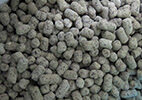
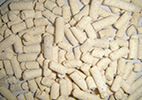
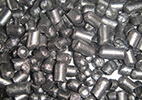
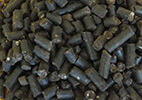
Organic fertilizer processing: Livestock and poultry manures—including fermented chicken, pig, sheep, cattle, and duck manure—are the primary materials used in flat die pelleting machine. Agricultural wastes—such as pulverized straw, rice husks, peanut shells, sawdust, and spent mushroom substrate—can be granulated either alone or mixed with manure. Organic raw materials like humic acid, peat, and oilseed cakes are also suitable.
Bio-organic fertilizer production: After fermenting organic materials, functional microbial agents (such as nitrogen-fixing, phosphate-solubilizing, and potassium-solubilizing bacteria) are added. The mixture is then granulated via flat-die extrusion at ambient temperature, ensuring high retention of viable bacteria and excellent biological efficacy in the final product.
Compound fertilizer production: Organic fertilizer base materials are mixed with small amounts of urea, ammonium phosphate, and potash before flat-die granulation. The resulting granules—characterized by high organic matter content and moderate nutrient concentrations—are ideal for cash crops, fruits, and vegetables.
Feed industry: Used for pelletizing compound feeds, concentrated feeds, and aquatic feeds; the resulting pellets are dense and water-resistant, making this a common setup for small- and medium-sized feed processing plants.
Biomass energy sector: Biomass powders—such as sawdust, straw, and peanut shells—can be compressed into pellet fuel using flat-die granulation. These pellets are suitable for biomass boilers or residential heating, thereby expanding the equipment’s range of applications.