
Large angle belt conveyors play a critical role in vertically lifting materials within fertilizer production lines, serving as essential equipment for achieving three-dimensional workshop layouts and efficient space utilization. In fertilizer production, equipment for processes such as crushing, mixing, and granulating is often arranged on platforms at varying heights; large angle belt conveyors establish a continuous material transport path between the ground level and these elevated platforms. By integrating horizontal transport and vertical lifting onto a single belt, they simplify transfer steps and reduce the total number of machines required, acting as a vital link in the material flow of modern fertilizer production lines.
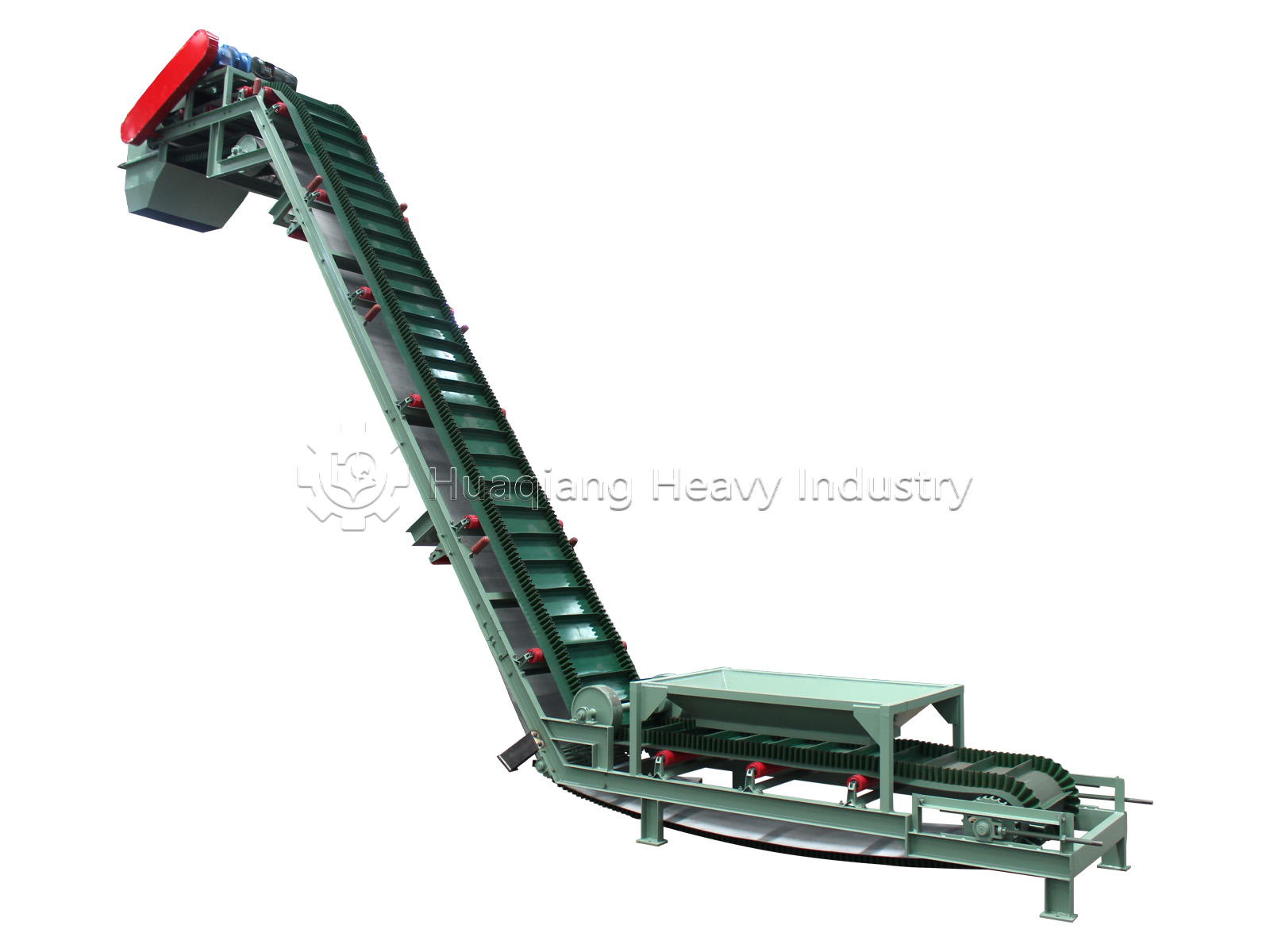
Material enters the system through the inlet, landing on the horizontal section or the lower part of the inclined section of the conveyor belt. Corrugated sidewalls and transverse cleats on the belt surface form individual conveying compartments. The drive unit powers the continuous movement of the belt, with the transverse cleats supporting the material as it is lifted upward. In vertical or steeply inclined sections, the cleats bear the weight of the material while the corrugated sidewalls provide lateral containment, securely holding the material in place on the belt. Upon reaching the top horizontal section or the discharge pulley, the belt inverts, and the material is discharged through the outlet. The empty belt then returns along the bottom section to complete the cycle.

A single belt replaces the combination of a horizontal conveyor and a separate elevator, reducing transfer points and equipment count.
Conveying angles are fully customizable, allowing for flexible design based on facility space without the limitations of fixed-angle systems.
Materials remain stationary on the belt during lifting, preventing breakage or segregation-making it ideal for granular fertilizers.
Fully enclosed design controls dust and odors, improving the workshop environment.
Operates smoothly with low noise levels and consumes less energy than bucket elevators of equivalent lifting height.

Specifications for steep-incline belt conveyors are determined based on material characteristics, lifting height, and conveying capacity. Belts with higher sidewalls should be selected for powdery materials to prevent dust generation, whereas lower sidewalls may be suitable for granular materials.
Lifting height dictates the required drive power and belt strength rating; reinforced base belts are necessary for lifting heights exceeding 20 meters. Conveying capacity is determined by belt width and speed; equipment selection should be based on the production line’s maximum capacity, incorporating a 10%–15% margin.
