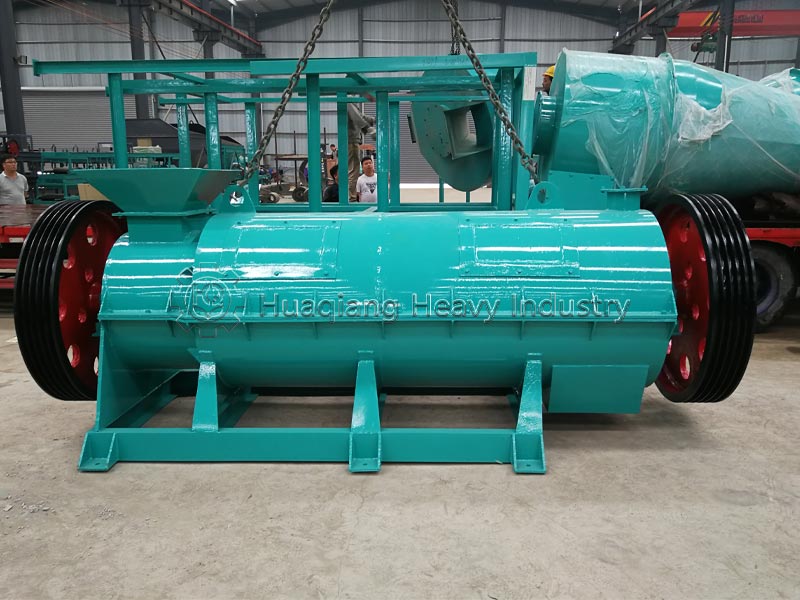
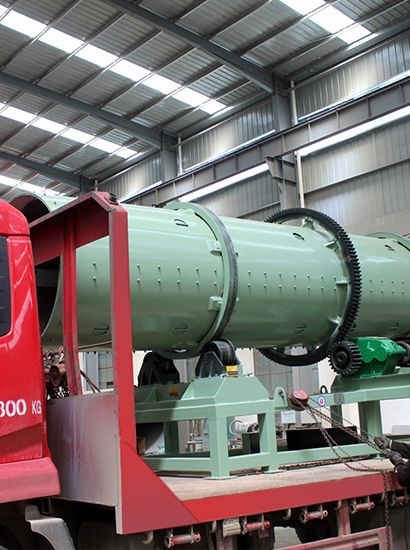
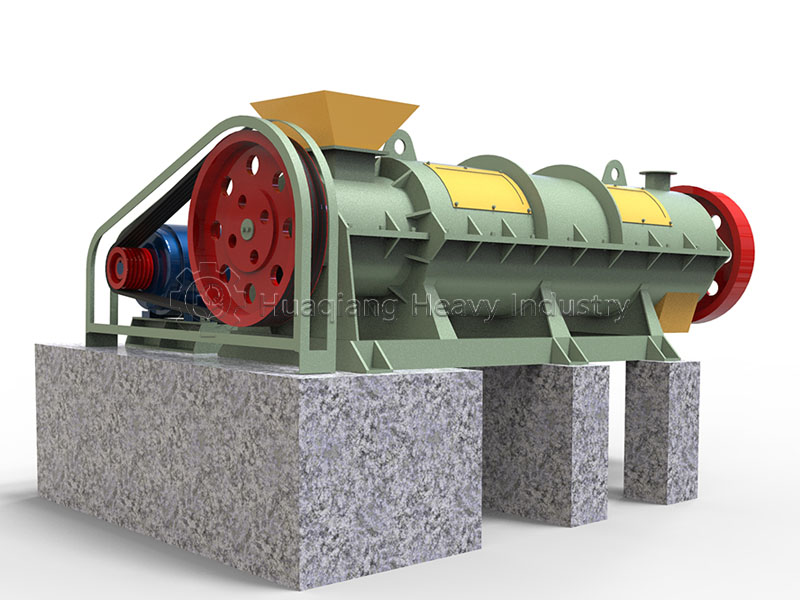
The new type organic fertilizer granulator is a wet granulation device specifically developed for the characteristics of fermented organic materials. It utilizes high-speed rotating stirring teeth in conjunction with the granulating cylinder to transform materials into spherical granules in a single pass through centrifugal throwing and rolling agglomeration under humidified conditions. Compared to traditional wet granulation methods like disc or drum granulation, this model features structural optimizations that prevent clogging and improve granulation rates and granule sphericity. It is particularly well-suited for processing fermented organic fertilizer feedstocks—such as chicken, sheep, and cattle manure—that are high in fiber and prone to significant moisture content fluctuations. The equipment offers rapid granulation speeds and produces uniform, dense granules; granulation occurs at ambient temperatures, ensuring minimal impact on the activity of functional microbial agents added to the fertilizer. With a compact structure, small footprint, and ease of operation and maintenance, it is an ideal granulator for small-to-medium-scale organic and bio-organic fertilizer production.
Powdered organic material is quantitatively fed into the granulation cylinder via a screw feeder; a high-speed rotating stirring tooth disc is installed at the bottom of the cylinder. Driven by the powerful throwing action of the stirring teeth, the material is flung toward the cylinder walls while its surface is moistened by atomized water or a binder solution sprayed into the chamber. Under the combined influence of centrifugal force and gravity, the moistened powder particles form a circulating, tumbling flow between the cylinder wall and the tooth disc. Through repeated collisions, adhesion, and layering, the powder particles gradually agglomerate into spherical granules. Within the material flow, the formed granules undergo natural classification; larger granules migrate toward the cylinder edge and spill out through the discharge outlet. Granule size and density can be flexibly controlled by adjusting the stirring tooth rotation speed, liquid spray volume, and feed rate. Throughout the process, the material experiences minimal temperature rise, moisture addition is precisely controlled, and the resulting granules are dense and uniform.

Cylinder and Frame: The cylinder features a vertical cylindrical structure; the inner wall is treated with an anti-stick coating or fitted with wear-resistant liners to effectively minimize material adhesion. The frame is constructed from welded structural steel, ensuring high overall rigidity and stable operation.
Agitating Disc Assembly: A rotating disc located at the bottom of the drum, equipped with several detachable agitating pins. Driven by the main motor, the disc rotates at high speed to fling the material into a uniform curtain; it is the core component for granulation. The surfaces of the agitating pins are wear-resistant treated, ensuring a long service life.
Spraying System: An annular spray pipe mounted above the drum, equipped with atomizing nozzles. The water flow rate is adjustable, ensuring even spraying over the area where the material tumbles. It can spray water or liquid binders to enhance the pelletizing effect.
Drive System: The main motor connects to the gearbox via belts or a coupling to drive the rotation of the main shaft and disc. The drive operates smoothly with adjustable speeds, accommodating the granulation requirements of various materials.
Feeding and Discharge Devices: The feed inlet is located at the top of the drum and connects to a screw feeder, ensuring quantitative and uniform feeding. The discharge outlet is positioned on the upper side wall of the drum; formed granules naturally overflow and proceed to subsequent drying or screening stages.
Electrical Control System: The control cabinet integrates functions for adjusting agitation speed, feed rate, and liquid spray volume. It offers simple operation with one-touch start/stop capabilities and can be integrated into a centralized production line control system.
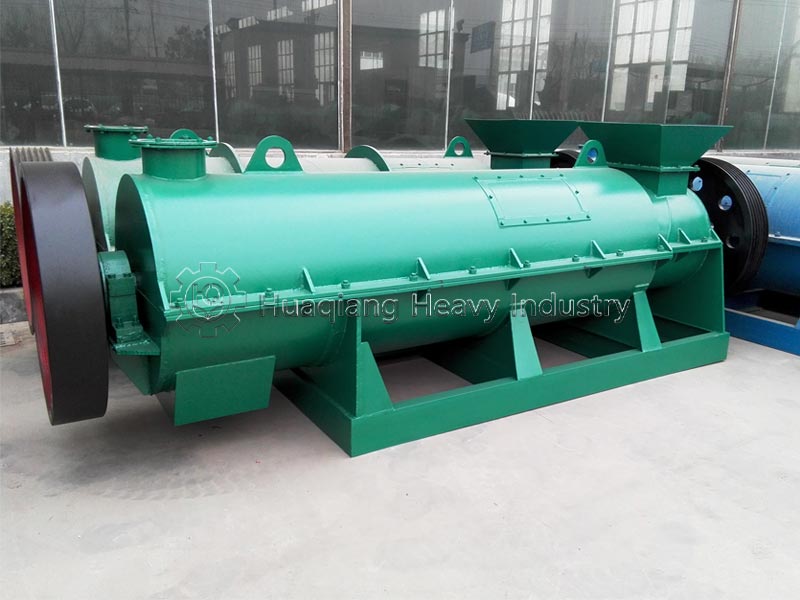
Strong Adaptability to Organic Materials: Specifically designed for fermented organic fertilizers; it handles materials with high fiber content and fluctuating moisture levels effectively, preventing clogging or sticking to the drum and ensuring smooth material flow.
High Pelletizing Rate and Uniform Granules: Combines centrifugal scattering with rolling agglomeration to achieve a pelletizing rate of 85%–92%. The resulting granules are spherical or near-spherical with smooth surfaces, offering an excellent commercial appearance.
Ambient Temperature Granulation Preserves Microbial Activity: No steam heating is required, and the material temperature rise during granulation is minimal. This maximizes the preservation of functional microbial activity in the organic fertilizer, making it ideal for bio-organic fertilizer production.
Wide Adjustable Operating Range: Agitation speed, liquid spray volume, and feed rate can all be adjusted independently. A single unit can produce spherical granules ranging from 2mm to 8mm in diameter, allowing for flexible production switching. Simple structure and easy maintenance: It lacks precision, easily worn parts such as ring dies or pressure rollers; mixing pins/rods can be quickly replaced; daily maintenance requirements are minimal, and operating costs are low.
Low energy consumption and investment: The new type organic fertilizer granulator has low power requirements, and for the same production capacity, its overall energy consumption is lower than that of ring-die or drum granulation processes. The new type organic fertilizer granulator is compact, requires a small footprint, and entails a lower initial investment for the production line.
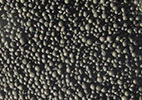

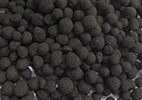
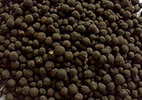
Organic fertilizer processing: Granulation of fermented livestock and poultry manures, such as chicken, pig, sheep, cattle, and duck manure.
Bio-organic fertilizer: Ambient-temperature granulation of bio-organic fertilizers enriched with functional microbial agents (such as nitrogen-fixing, phosphorus-solubilizing, and potassium-solubilizing bacteria).
Organic-inorganic compound fertilizer: Wet granulation of mixtures comprising organic materials and small amounts of chemical fertilizers.
Agricultural waste resource utilization: Granulation of agricultural wastes—such as straw powder, rice husk powder, spent mushroom substrate, and biogas residue—into fertilizer.
Feed and fermented feed: Processing of fermented feed and protein-rich feed into spherical granules.