
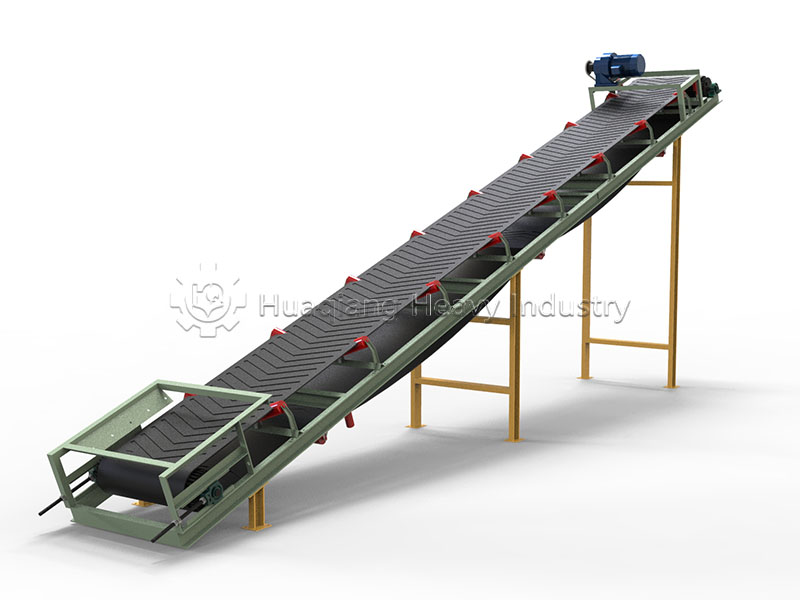
Belt conveyors are the most widely used continuous conveying equipment in the fertilizer industry. The conveyor belt serves as both the traction and load-bearing mechanism, continuously transporting materials from one point to another. They are widely used in organic fertilizer and compound fertilizer production lines, connecting various processes such as crushing, mixing, granulation, drying, cooling, screening, and packaging, enabling long-distance, high-volume transport of powdery, granular, and small lump materials. The equipment has a mature structure, stable and reliable operation, and is easy to maintain. Horizontal, inclined, or convex/concave conveyor lines can be flexibly arranged according to the workshop layout, making it an indispensable basic equipment for fertilizer enterprises to achieve mechanized and automated production.
The conveyor belt forms a closed loop around the head drive roller and the tail idler roller, supported by upper and lower idler rollers. The drive motor drives the head roller to rotate via a reducer, and the conveyor belt runs continuously due to the friction between the roller surface and the conveyor belt. Material falls onto the conveyor belt from the tail feed hopper, moving forward with the belt surface. When it reaches the head roller, the conveyor belt turns, and the material is discharged into the discharge hopper under the action of gravity and centrifugal force. The upper belt surface is the load-bearing section, and the lower belt surface is the return section. The entire process ensures stable material transport without breakage or stratification.

Conveyor Belt: A ring-shaped belt made of rubber or plastic, bearing the weight of the material and traction force. Various specifications are available, including standard, heat-resistant, and oil-resistant types.
Drive Unit: Composed of a motor, reducer, coupling, and drive drum, providing power to the conveyor. Variable frequency speed control can be configured.
Drums: The head drum is the drive drum, with a rubber-coated surface to increase friction; the tail drum is the redirecting drum, equipped with a spiral tensioning or counterweight tensioning device.
Idler Group: The load-bearing section uses trough-type idlers to increase carrying capacity; the return section uses parallel lower idlers; buffer idlers and transition idlers are also available.
Frame: Constructed from welded or bolted steel sections, supporting the idlers and conveyor belt. It consists of a head frame, tail frame, and intermediate frame.

Tensioning Device: Ensures sufficient tension on the conveyor belt to prevent slippage and deviation. Spiral tensioning or counterweight tensioning is commonly used.
Sweeper: A scraper sweeper at the head removes surface-adhering material, and a hollow section sweeper at the tail prevents debris from being rolled into the drum.
Guide chute and protective cover: A guide chute at the feed point ensures the material falls onto the belt in a centered position. A dust cover can be installed throughout the entire process for sealing.
