
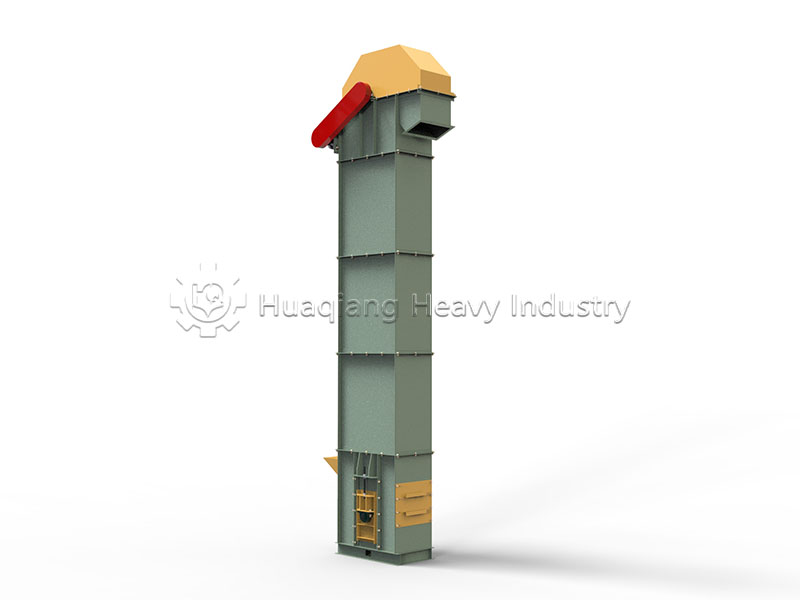
Bucket elevators play a crucial role in the vertical material transport of modern fertilizer production lines, serving as core equipment for achieving three-dimensional layout and efficient space utilization in the workshop. In fertilizer production, various process equipment are often arranged on platforms at different heights. Bucket elevators, within a sealed casing, vertically lift materials from the ground or lower levels to higher levels, supplying materials to high-level equipment such as granulators, coolers, screening machines, and packaging machines. Together with horizontal belt conveyors and inclined belt conveyors with large angles, they form a three-dimensional conveying network for fertilizer production lines, making them indispensable material lifting equipment for fertilizer enterprises with capacities exceeding 10,000 tons to achieve fully automated production.
Material is fed into the bottom base of the elevator by the feeding equipment and is scooped up or flows into buckets fixed to a traction belt or chain. The drive motor drives the top drive wheel through a reducer, pulling the buckets vertically upwards. Upon reaching the top, the buckets tilt and discharge to the outlet. The empty buckets return to the bottom from the other side of the cylinder for reuse. The material is kept within a fully enclosed casing throughout the lifting process. The lifting capacity can be adjusted online via frequency conversion speed control, achieving precise matching with the capacity of upstream and downstream equipment.

Vertical lifting saves space; the casing cross-section is only a few square meters, saving significant workshop area compared to inclined belt conveyors.
Fully sealed, dust-free conveying; no material leakage or dust escape, environmentally friendly.
Highly adaptable to lifting height; flexible to meet different height requirements by adding or removing drum sections.
Large single-unit lifting capacity, meeting the vertical material transfer needs of high-capacity production lines.
Combined with horizontal belt conveyors, it forms a complete conveying network, achieving full plant logistics automation.

Select the traction component type and bucket type based on material characteristics. Dry, loose materials use belt elevators with deep buckets; wet, sticky organic fertilizers use chain elevators with shallow buckets or trough buckets.
The lifting height determines the drive power and traction component strength level. For heights exceeding 30 meters, reinforced traction belts or high-strength chains are recommended.
The conveying capacity is determined by the bucket volume, bucket spacing, and operating speed. Select the model based on the maximum production line capacity, leaving a 10% margin.
