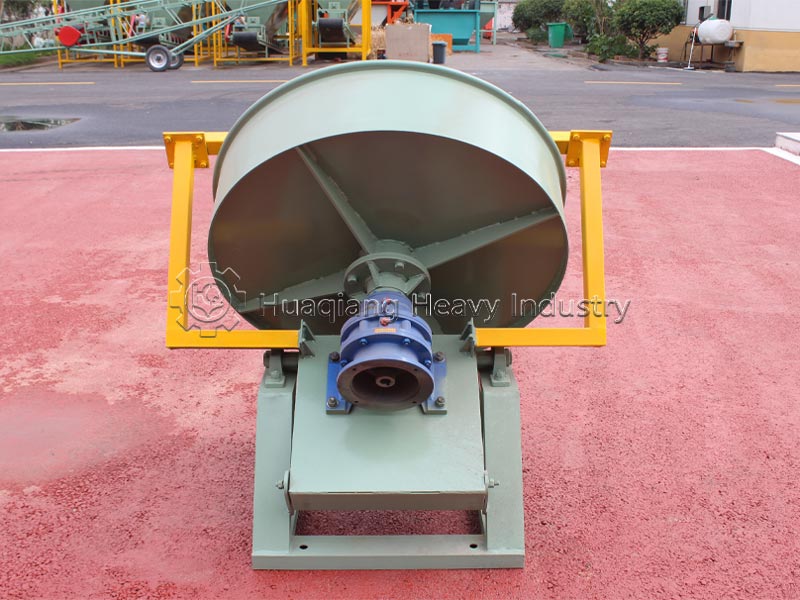
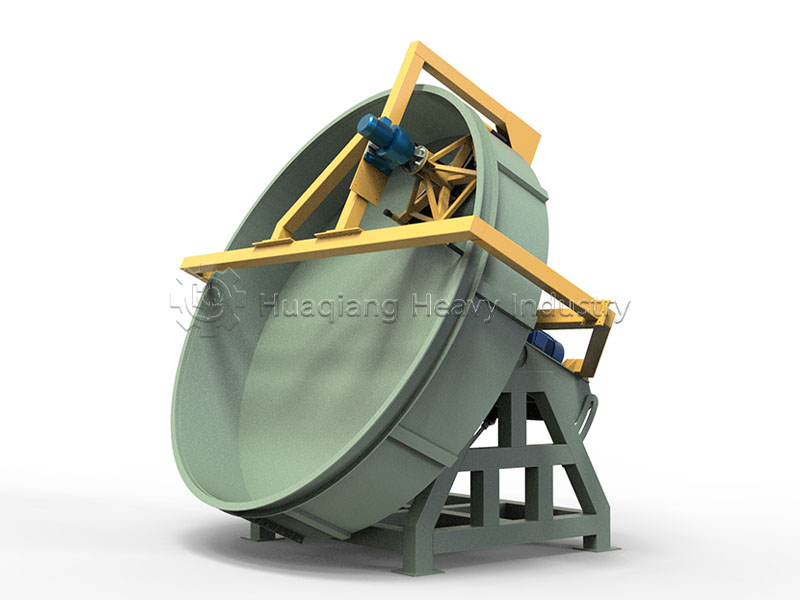
In a fertilizer production line, the disc granulator plays a pivotal role, bridging the upstream batching and mixing systems with the downstream drying, screening, and packaging stages. It is here that the material transforms from powder into granules. The equipment itself is uncomplicated; operators standing nearby can intuitively assess the quality of the granulation. The disc granulator has maintained a strong position in the industry not through complex technology, but through tangible advantages: simplicity, reliability, ease of operation, and ease of maintenance. For fertilizer manufacturers, it represents a time-tested, mature solution.
Raw Material Preparation: Various base fertilizers and additives are metered according to the formula and fed into a mixer. They are blended thoroughly while the particle fineness is controlled to meet specific requirements. The mixed powder is then conveyed via a lift to a feed hopper located above the disc, awaiting the granulation stage.
Nucleation (Seed Pellet Formation): As the powder falls onto the rotating disc, a spray system simultaneously applies atomized water or a binder solution. Driven by liquid surface tension, the moistened fine powder particles aggregate into small cores—roughly the size of millet grains—known as “seed pellets.”
Granule Growth: The seed pellets tumble across the disc surface, continuously coming into contact with newly added dry powder and mist droplets. Layers of powder adhere to their surfaces, causing the particle size to increase incrementally. This process resembles rolling a snowball; the granules circulate along specific trajectories within the disc, becoming progressively larger and denser.
Discharge and Screening: Once the granules reach the target size, their weight overcomes the friction of the disc surface. Driven by the combined forces of centrifugal action and gravity, they automatically migrate to the disc’s edge and spill over. The discharged granules enter a vibrating screen; oversized or correctly sized granules proceed to the drying stage, while undersized fines are returned to the disc for further granulation.
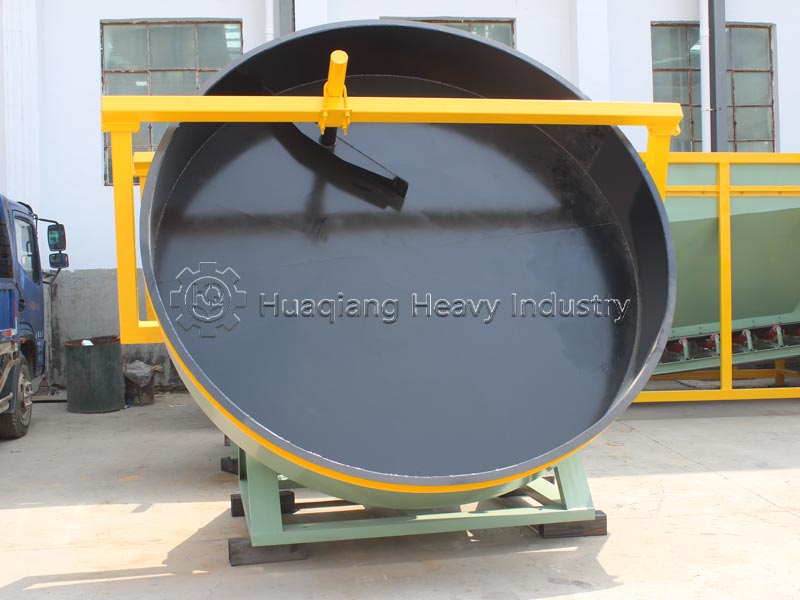
Excellent Granule Roundness: As materials tumble and bond freely within the disc, the resulting granules are naturally spherical or near-spherical. They feature smooth surfaces with minimal sharp edges, resulting in a high-quality commercial appearance—a significant selling point in the fertilizer market.
Highly Intuitive Process: The entire pelletizing process is fully visible on the open-type disc, allowing operators to visually assess the condition of the pellets—such as whether they are too large or too small—at a glance, with adjustments yielding immediate results. The technical requirements for operators are relatively low.
Particle size adjustment is flexible and convenient. A single piece of equipment can produce various finished particle sizes within a specific range by adjusting the disc’s inclination angle, rotational speed, water spray volume, and material feed position. This capability is highly valuable for manufacturers who need to flexibly adjust their products based on market conditions.
Material recycling efficiency is high. Fine powder and unpelletized material separated during screening are returned directly to the disc to mix with fresh feed for continued granulation; this minimizes powder waste and maximizes raw material utilization, with an overall pelletization rate exceeding 80% under proper operation.
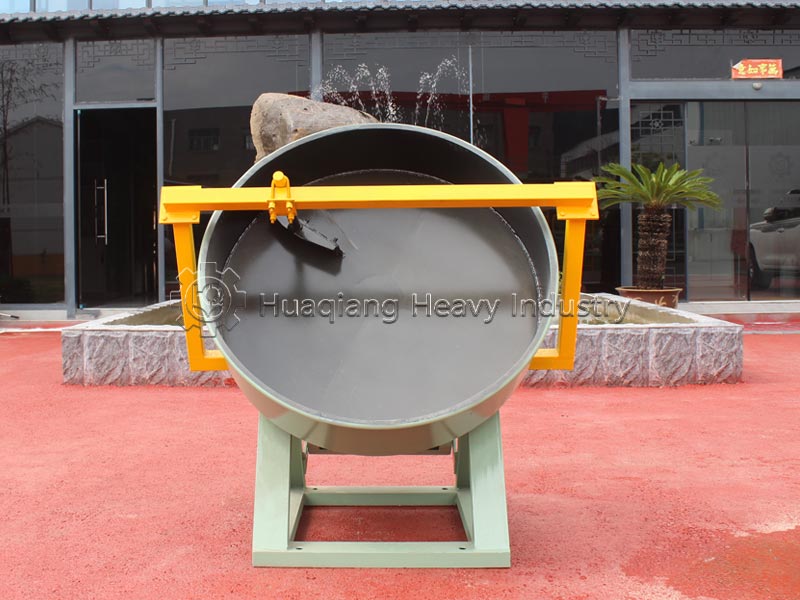
In the process layout, the disc granulator is typically positioned after the batching and mixing stage and before the drying and cooling stage. Uniformly mixed powder is conveyed via a bucket elevator to a hopper above the disc, with the feed rate controlled by a metering feeder. After granulation, the wet pellets overflow onto a conveyor belt, which transports them to a dryer for moisture removal, followed by a cooler for temperature reduction and a screen for classification, before finally entering the coating and packaging section.
Integration with the drying system. Pellets discharged from the disc typically have a moisture content of 15%–20%, which must be reduced in the dryer to meet storage standards for commercial fertilizer. Drying temperature and duration settings must be adjusted based on the pellet size and initial moisture content; the coordination of these process parameters directly impacts finished product quality and energy consumption.
Screening and material recycling. Fine powder and undersized pellets retained by the screen are returned to the disc via a recycle conveyor for further granulation. This closed-loop cycle maintains a stable material balance throughout the production line, preventing the accumulation or shortage of powder material.
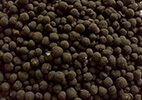
In the fertilizer industry, it covers a wide range of product varieties currently popular on the market. Compound fertilizers of high, medium, and low concentrations represent the largest application sector; organic-inorganic compound fertilizers—specifically those with an organic matter content of no more than 30%—achieve excellent results with disc granulation. Bio-organic fertilizers benefit from the disc granulator’s ambient-temperature processing, which maximizes the retention of the activity of added microbial agents; specialty fertilizers, such as humic acid and silicon-based fertilizers, are also suitable for this granulation method.
In the building materials industry, the pelletizing of cement raw meal is a traditional application for disc granulators; fine powder is rolled into pellets measuring 10–20 mm within the disc before being fed into the kiln for calcination. Materials such as limestone powder can also be processed into pellets using this equipment.
In the metallurgical and environmental protection sectors, iron ore concentrate is pelletized for use in pellet ore production, while industrial waste residues—such as dust-collector ash and sludge incineration ash—undergo solidification via disc granulation, facilitating transport, stockpiling, or further utilization.