
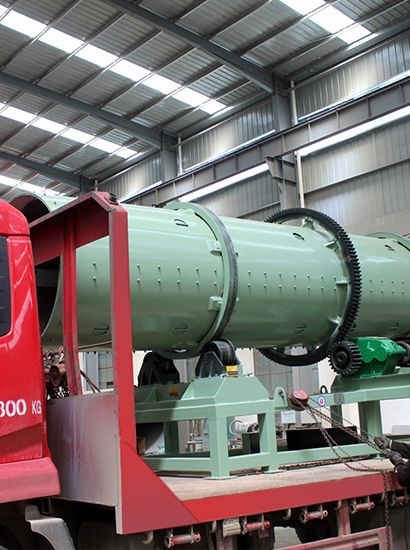
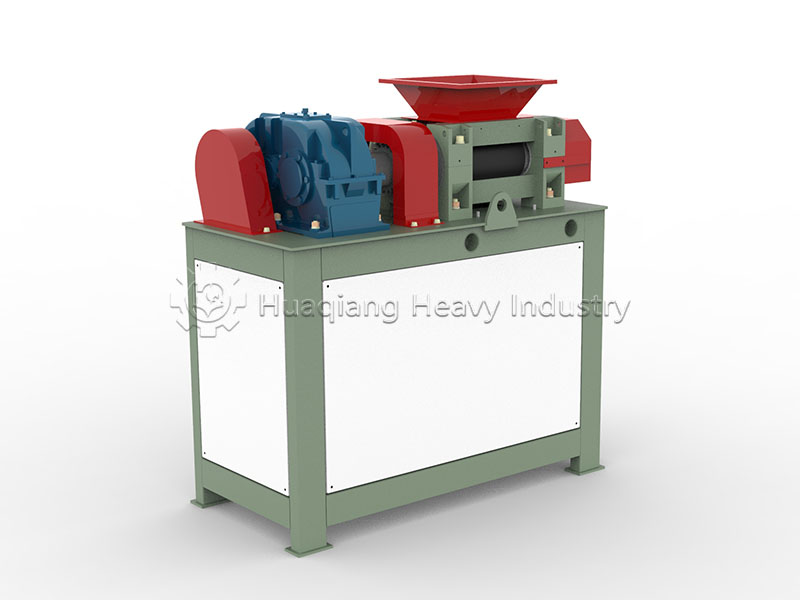
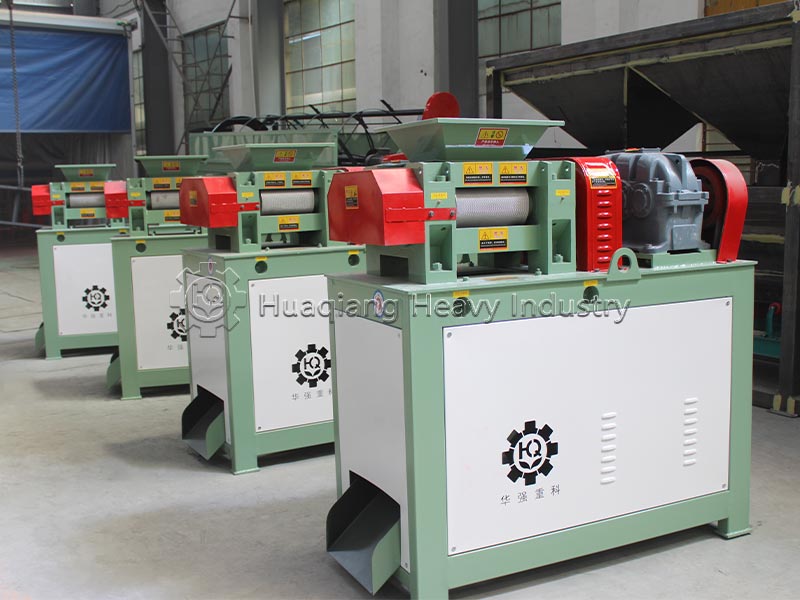
In the field of compound fertilizer granulation, the double roller press granulator represents a mature and practical choice. Instead of relying on liquid-phase granulation, it uses mechanical pressure to compress a mixture of fertilizer powders directly into granules. This enables the consistent production of uniform, solid granules, even when handling formulations such as high-nitrogen, high-potassium, or organic-inorganic hybrid types. An increasing number of compound fertilizer manufacturers are adopting this equipment as their primary granulation unit or as a flexible addition to production lines for product diversification.
Raw Material Pre-treatment: Various raw materials are precisely metered according to the formula, crushed to the required fineness, and then thoroughly mixed. The resulting powder mixture must meet specific requirements for fineness (at least 60% passing through an 80-mesh screen) and moisture content (5%–12%).
Forced Feeding: The powder mixture is conveyed to the main machine’s hopper and then forced into the gap between the rollers by a variable-frequency screw feeder. The speed of the screw feeder is interlocked with the speed of the main pressure rollers to ensure the feed rate precisely matches the forming speed.
Double-Roller Extrusion and Forming: This is the core stage of the process. Two parallel, counter-rotating rollers—driven by high pressure from a hydraulic system—”bite” the fed powder into the pockets on the roller surfaces. Within these pockets, the powder is instantly compressed to near-true density, forming oblate or spherical granule preforms.
Crushing and Disintegration: The extruded material typically emerges as continuous sheets; a low-speed, toothed breaking roller positioned below “tears” these sheets apart, separating them into individual granules.
Screening and Material Recycling: An upper screen captures oversized granules and incompletely broken sheets, returning them via a chute to the breaking roller for reprocessing; a lower screen separates fine powder, which is combined with fresh raw material for re-granulation; the middle layer consists of the finished granules, which are conveyed to the packaging section.
Ambient-temperature operation and flexible formulations: Unconstrained by material melting points or solubility; high-nitrogen formulas and low-melting-point components can be successfully granulated.
Single-step forming and streamlined workflow: The process converts powder into finished granules via a single extrusion step, eliminating intermediate stages such as water addition, drying, and cooling.
Controllable granule quality: Granule hardness and size can be precisely regulated by adjusting hydraulic pressure and the dimensions of the roller surface pockets.
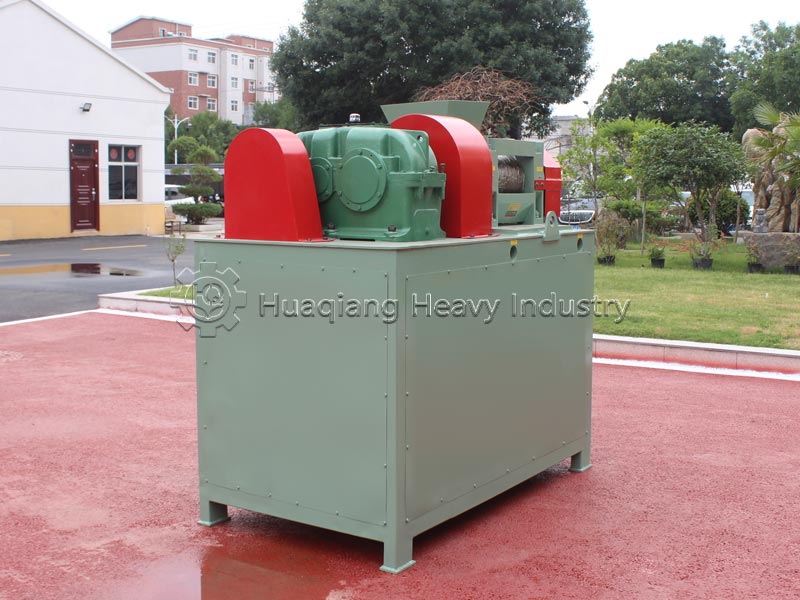
Post-batching integration: Typically positioned after the automatic batching, mixing, and pulverizing stages. Powder that is uniformly mixed and meets fineness requirements is conveyed via a bucket elevator to the hopper above the main unit, where granulation begins immediately.
Closed-loop connection with the screening system: Fine powder separated during screening is returned to the mixer or directly to the main unit’s hopper via a return conveyor. This creates a “granulation–screening–material return–re-granulation” loop, ensuring high powder utilization and an overall granulation rate exceeding 95%.
Integration with coating and packaging: Screened, qualified granules enter the coating machine (if anti-caking treatment is required) before proceeding to the weighing and packaging system for final output.
Parallel or alternative to wet-process lines: Some manufacturers operate dry-process double-roller lines alongside existing rotary drum or pan granulation lines. Wet-process lines handle standard formulas, while dry-process lines specialize in difficult-to-granulate formulas—such as high-nitrogen or organic-inorganic blends—creating complementary production capabilities.
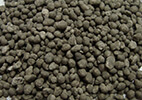
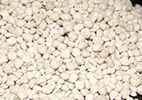
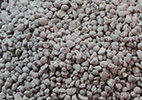
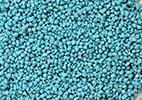
High-concentration compound fertilizers: Formulas with total N-P-K nutrients ≥40% (e.g., 15-15-15, 17-17-17). The powder exhibits good cohesiveness, facilitating easy double-roller extrusion; the resulting granules possess high strength and a smooth, rounded appearance, ensuring strong market acceptance.
High-nitrogen compound fertilizers: Formulas with nitrogen content ≥20% (e.g., 25-10-5, 30-5-5). Wet granulation often leads to issues with urea melting and crystallization, whereas dry double-roller pressing at ambient temperature avoids these problems entirely, resulting in granules that neither cake nor soften. High-potassium compound fertilizers: Formulations with a potassium content of ≥20%, such as 10-10-25 or 12-8-30. Potassium chloride or potassium sulfate powders exhibit good formability under pressure, resulting in dense granules.
Organic-inorganic compound fertilizers: Formulations containing ≥20% organic matter and ≥15% total nutrients. When organic materials are blended with inorganic fertilizers, roller compaction allows for granulation at ambient temperature without degrading the organic components; the resulting granules combine the long-lasting effects of organic fertilizer with the rapid action of chemical fertilizer.
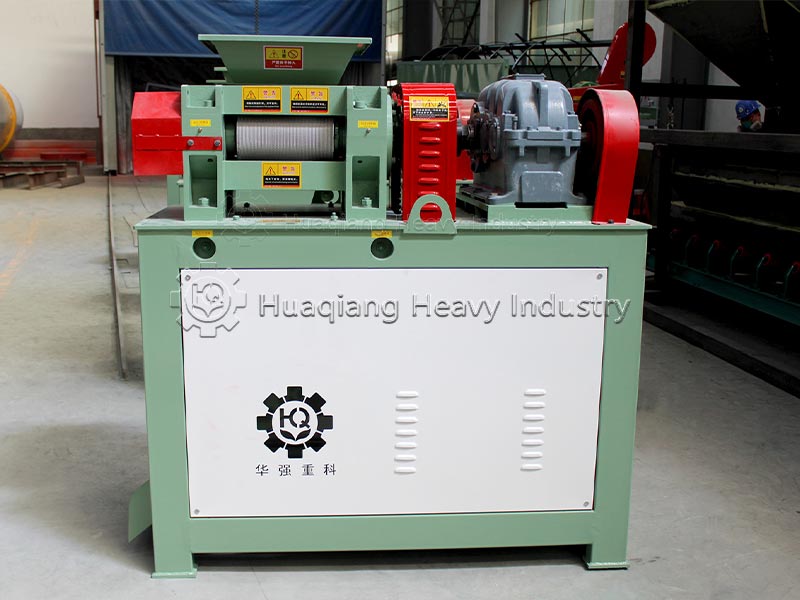
| Model | DZJ-I 1.0 | DZJ-I 2.0 | DZJ-I 3.0 | DZJ-I 3.0 |
| Capacity (t/h) | 1-1.5 | 1.5-2.5 | 2-3 | 3-4 |
| Power (Kw) | 11 | 18.5 | 22 | 45 |
| Roller Dimension(mm) | ø150×220 | ø150×300 | ø186×300 | ø300×300 |
| Feed Material Size(mm) | <=0.5 | <=0.5 | <=0.5 | <=0.5 |
| Output Granules Size(mm) | ø2.5-ø10 | ø2.5-ø10 | ø2.5-ø10 | ø2.5-ø10 |
| Gearbox Model | ZLY-160 | ZLY-160 | ZLY-180 | ZLY-224 |
| Rotation Speed (r/min) | 60 | 60 | 60 | 60 |