
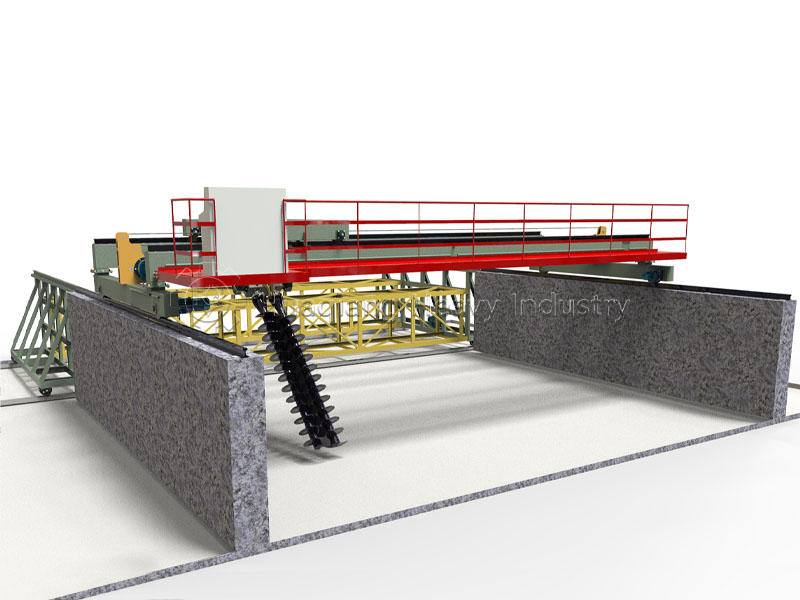
The double screws compost turning machine is a type of trough-style fermentation turning equipment that utilizes two parallel screw shafts as its core turning components. Unlike simple trough turners that rely on rotating toothed rollers, the twin-screw turner employs two shafts equipped with continuous helical blades to turn and advance the material. The two screw shafts rotate either in the same or opposite directions, scooping up material from the bottom of the trough along the helical surfaces, turning it over, and pushing it toward the discharge end—thereby accomplishing both turning and displacement in a single pass. The screw structure exerts stronger cutting and mixing forces on the material, effectively breaking up clumps and shredding long fibers, which results in greater fermentation uniformity. The equipment travels back and forth along rails mounted on the fermentation trough; the turning depth and travel speed are adjustable, making it suitable for processing organic materials with high moisture content that are prone to clumping. Characterized by high processing efficiency and stable operation, the double screws compost turning machine is a technologically mature and widely used model in trough-style aerobic fermentation processes.
The working principle of the double screws compost turner relies on the rotating cutting and pushing action of the helical blades. The machine spans the fermentation trough, and a travel mechanism drives the entire unit forward at a constant speed along the trough rails. It features two main turning shafts installed in parallel within the trough, each fitted with welded continuous helical blades. Motors drive the two shafts to rotate at a specific speed; the helical blades cut into the material layer from the bottom of the trough, scooping up the material along the blade surfaces much like a screw conveyor. During rotation, the material is turned, cut, and broken up by the blades while simultaneously receiving axial thrust toward the discharge end. Under the action of the blades, the material gradually moves forward along the length of the trough, completing the turning and displacement process. The rotation direction of the two shafts can be configured according to process requirements, creating a shearing and mixing effect that ensures thorough exchange of material between different layers. The turning depth is adjusted by varying the distance between the screw shafts and the trough bottom, while the travel speed controls the thoroughness of the turning process and the distance of material displacement.
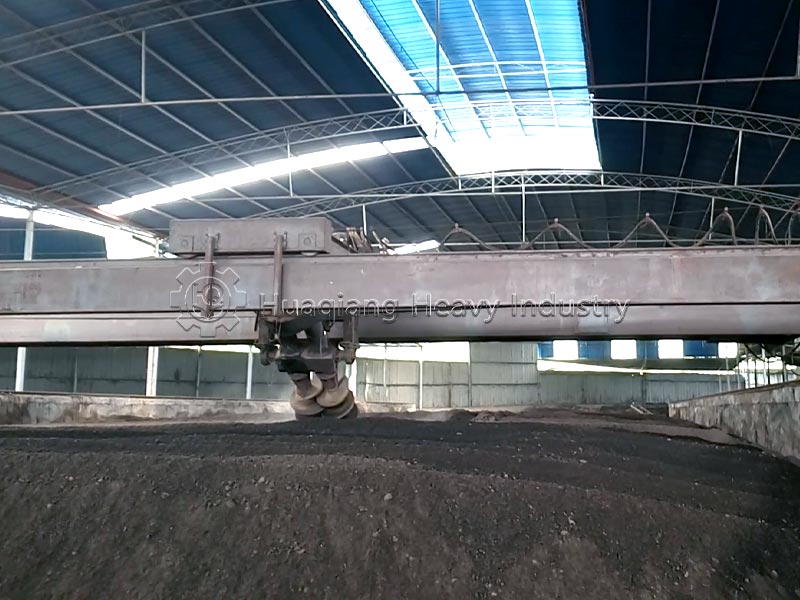
Frame and Travel Mechanism: A gantry-style frame welded from structural steel, supported by travel wheels at both ends that run along rails on the fermentation tank. A travel motor drives the wheels via a gearbox, with adjustable travel speed.
Twin-Screw Turning Shafts: The core components consist of two parallel screw shafts with continuous helical blades welded onto them. The blades are made of wear-resistant steel plate with hard-faced edges and are designed for easy removal and replacement. The spacing between the shafts and the screw direction are engineered to meet specific mixing and material displacement requirements.
Turning Drive System: A motor drives the rotation of the two screw shafts through a gearbox and gear transmission. The shafts can rotate synchronously in the same direction or in opposite directions; the drive system ensures matched rotational speeds and stable torque output.
Lifting and Adjustment Mechanism: Hydraulic cylinders or screw-jack mechanisms raise and lower the entire screw shaft assembly to adjust the turning depth. During shutdown or relocation, the shafts are raised to a high position, clearing the material.
Electrical Control System: The control cabinet integrates functions such as screw shaft start/stop, travel speed control, and lifting adjustments; it can be configured with automatic reciprocating and timed operation programs.
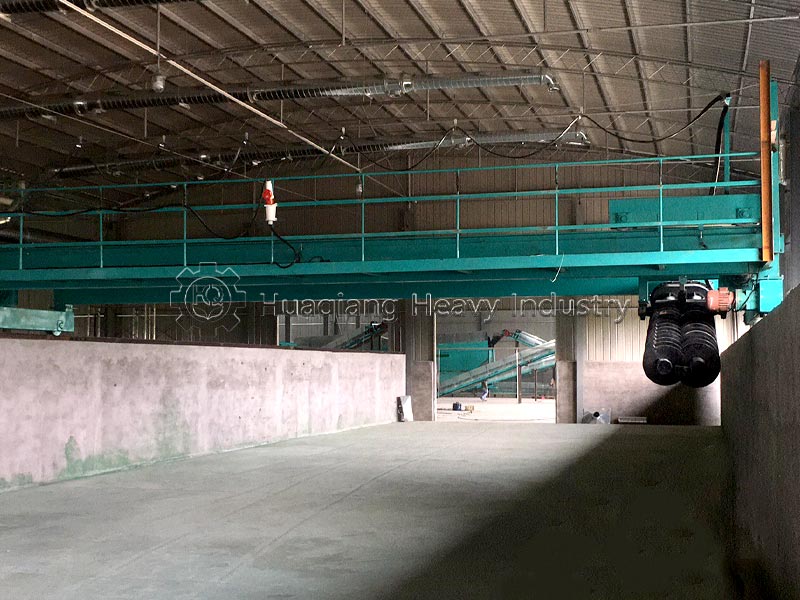
Excellent Mixing Uniformity: As the twin screw blades rotate, they continuously cut and turn the material, repeatedly exchanging material between different layers; this results in more consistent fermentation within the tank compared to single-shaft turning equipment.
Strong Clump-Breaking Capability: The cutting and tearing action of the screw blades effectively breaks up agglomerated material, making it highly effective for processing materials prone to caking, such as pig manure and sludge.
Ample Oxygen Supply and Rapid Temperature Rise: Material is lifted and dropped by the screw blades, creating a large surface area for air contact and ensuring sufficient oxygen replenishment; this promotes vigorous aerobic microbial activity and a rapid rise in temperature within the tank.
High Moisture Evaporation Efficiency: Continuous turning and dispersion of the material accelerate the escape of excess moisture, allowing for flexible control of material humidity by adjusting the turning frequency.
Stable and Controllable Material Displacement: The pitch and rotational speed of the spiral blades determine the distance the material moves toward the discharge end during each turning cycle; the displacement is precisely adjustable, facilitating easy management of the fermentation cycle.
Smooth Operation with Minimal Vibration: The dual-spiral structure offers excellent dynamic balance, significantly reducing machine vibration and noise during rotation compared to single-shaft toothed-roller designs.
