
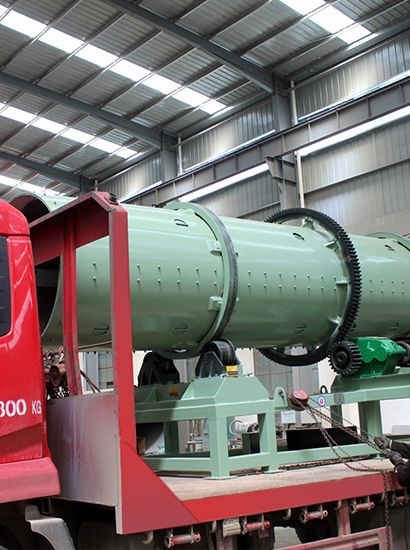
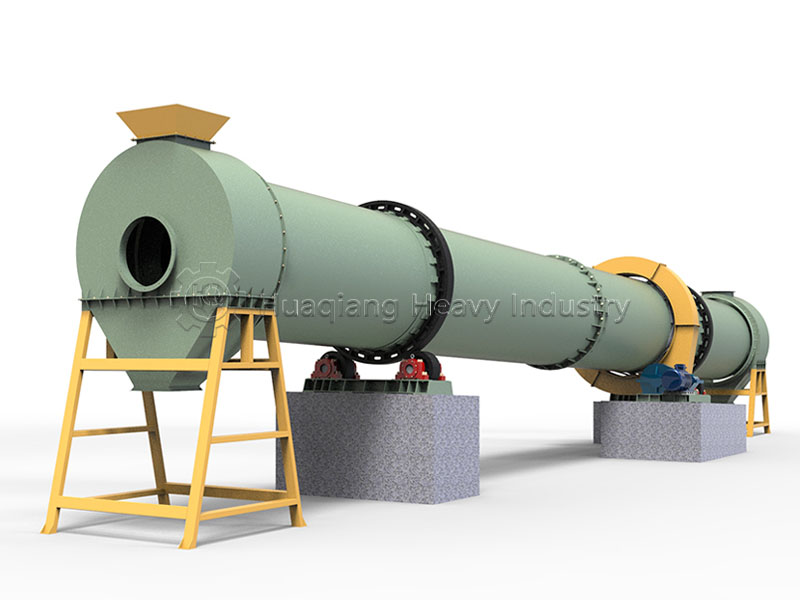
The drum fertilizer dryer is a critical piece of process equipment in fertilizer production lines, used to control the moisture content of the finished product. Granulated fertilizer typically has a moisture content of 15%–30% and must be dried to below safe moisture standards before packaging and storage. By controlling inlet air temperature, airflow, and material residence time, the dryer precisely reduces granule moisture to the target range while enhancing granule hardness and strength, making it essential for ensuring the quality of the finished fertilizer.
Upon entering the rotating drum, wet material is repeatedly lifted and scattered by internal lifting flights, creating a uniform curtain of material. Hot air generated by a hot-blast stove is fed into the drum, facilitating thorough heat exchange with the material. Surface moisture evaporates first, while internal moisture gradually migrates to the surface and evaporates subsequently. By controlling the hot air temperature and material residence time, the moisture content is progressively reduced to the set value. The dried material is then discharged through the outlet.

Organic fertilizer granules: Granules made from fermented chicken, pig, or cattle manure.
Compound fertilizer granules: High, medium, and low-concentration compound fertilizer granules.
Bio-organic fertilizer granules: Organic fertilizer granules containing functional microbial agents (require low-temperature drying).
Organic-inorganic compound fertilizer granules: Products granulated from a mixture of organic and chemical fertilizers.
Single-nutrient fertilizer granules: Drying of finished products such as granular urea or granular ammonium phosphate.

Drying temperature is the primary control parameter. For organic fertilizer granules, the temperature is generally controlled between 60°C and 150°C; excessively high temperatures can scorch organic matter and kill beneficial microbial populations. Drying temperatures for compound fertilizer granules can be raised to 150°C–250°C but must be adjusted based on the nitrogen content of the formula to prevent urea from melting and clumping at high temperatures.
