
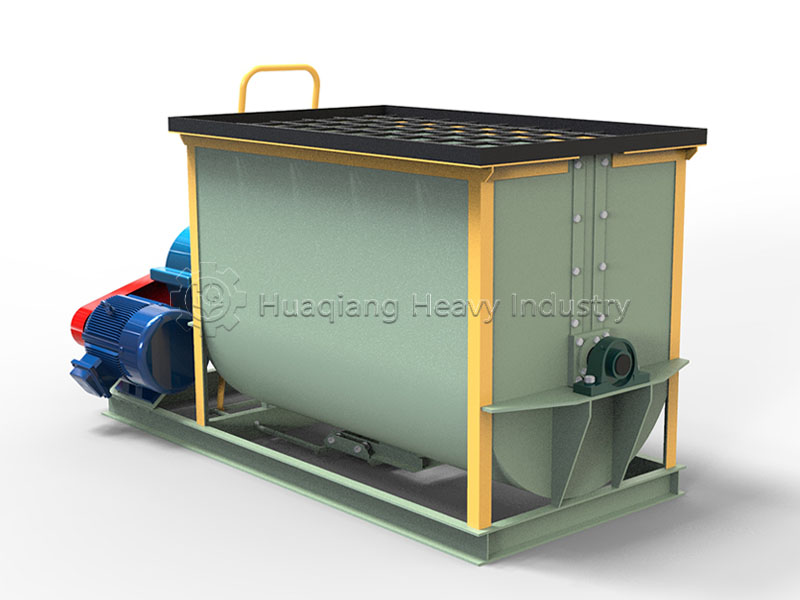
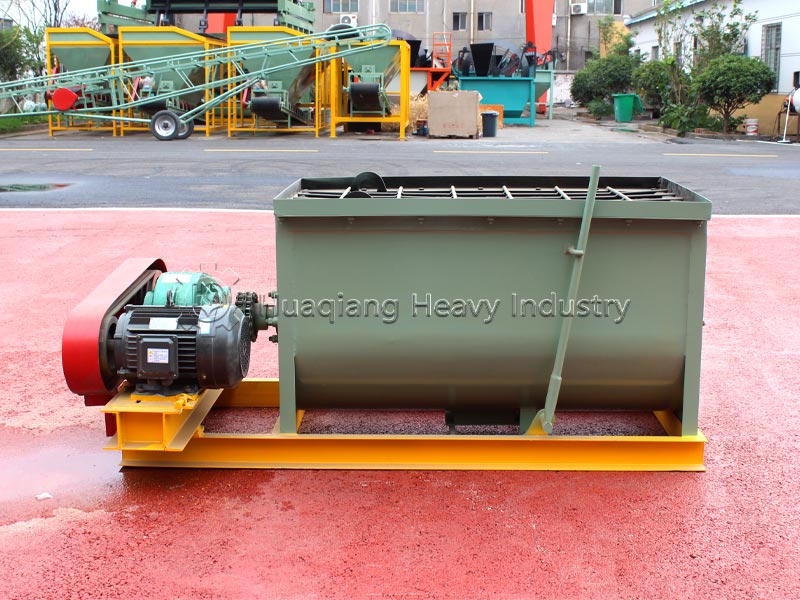
The horizontal ribbon mixer is a key piece of equipment in the ingredient mixing stage of organic and compound fertilizer production lines; it is responsible for uniformly blending various raw materials according to specific formula ratios. In fertilizer production, the uniformity of the mixture directly affects subsequent granulation results and the distribution of nutrients in the final product, making the mixer essential for ensuring product quality. The equipment can process mixtures of organic and inorganic fertilizers, compound fertilizers with added trace elements, and bio-organic fertilizers inoculated with functional microbial agents.
The main shaft drives the mixing blades to rotate, subjecting the material within the mixing trough to both thrust and shear forces. The blades are arranged at specific helical angles; as they rotate, they push the material axially in two directions, creating a circulating, tumbling flow. Through repeated convection and diffusion, the various components interpenetrate and blend. A liquid spraying system allows for the simultaneous addition of water or liquid binders, ensuring thorough contact and mixing between liquid and solid materials. Once mixing is complete, the discharge gate is opened to release the product.
Organic fertilizer materials: Blending fermented organic fertilizer powder with functional microbial agents.
Compound fertilizer materials: Mixing inorganic fertilizers (such as urea, ammonium phosphate, and potash) with fillers.
Organic-inorganic mixtures: Uniform blending of organic fertilizers and chemical fertilizers.
Trace element addition: Uniform dispersion of small amounts of trace elements into large quantities of base material.
Feed materials: Blending various ingredients for compound animal feed.

Input material particle size should not be excessive; generally, powder fineness should be below 2mm, as oversized particles can compromise mixing uniformity and reduce the service life of the mixing blades.
