
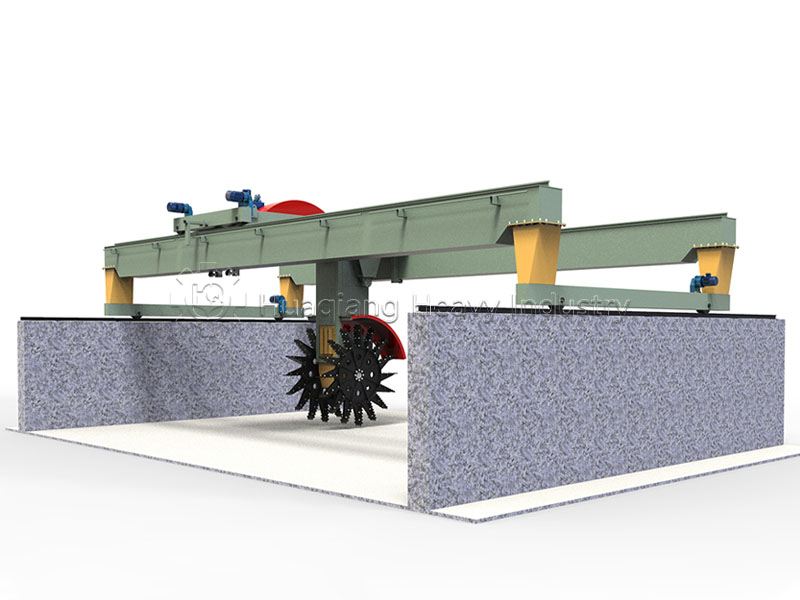
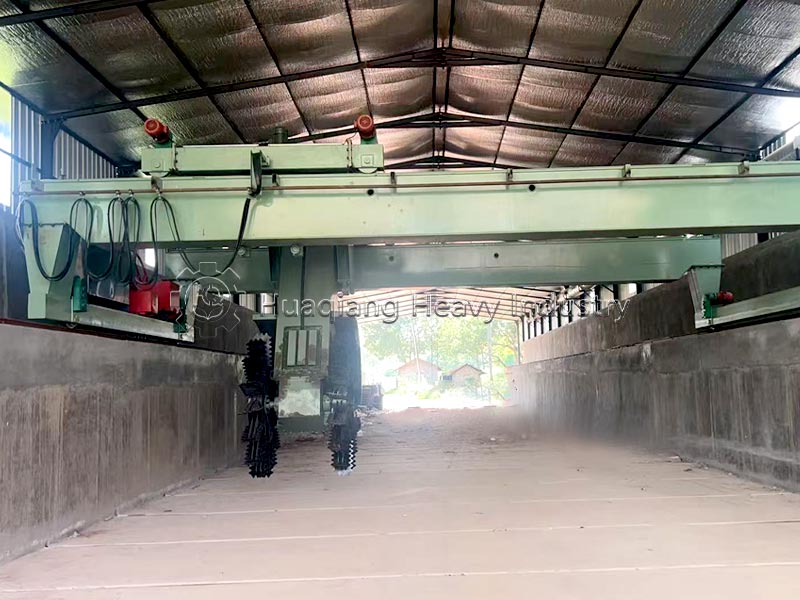
The large wheel compost turning machine is a fermentation turning machine that utilizes a rotating disc as its core component; it is primarily used to turn, break up, and displace piled materials during the aerobic fermentation process of organic fertilizer. Unlike trough-type turners that operate by spanning across fermentation troughs, this machine employs one or two large rotating discs that cut into the material pile. Turning teeth mounted on the discs scoop up the material and cast it backward. Driven by a travel mechanism, the machine advances along the length of the pile, simultaneously turning and displacing the material in a single pass. It is highly adaptable to various fermentation facilities, suitable for both trough-based fermentation and ground-based windrow composting. Featuring a compact structure, deep turning capability, and high processing efficiency, it is ideal for the aerobic fermentation of livestock manure, crop stalks, and other organic wastes, making it a popular choice for small- to medium-scale composting projects.
The large wheel compost turning machine performs its operations through the coordinated action of the rotating disc(s) and the travel mechanism. The core component consists of one or two large-diameter rotating discs—mounted either vertically or at an angle—featuring multiple sets of turning teeth or shovels evenly distributed along their circumference. During operation, the disc rotates at high speed, driven by a motor; the turning teeth cut into the base of the pile, scooping up material along the disc’s tangential path. As the disc continues to rotate, the material is lifted to a certain height before being cast backward by the combined forces of centrifugal action and gravity. It disperses in the air and lands back on the pile surface, with the landing point shifted backward relative to the original position. Simultaneously, the travel mechanism drives the machine frame slowly forward along the pile; as the disc rotates and turns the material, the entire machine advances, gradually turning the pile and shifting it backward from its original location. The degree of turning and the distance of material displacement can be controlled by adjusting the disc rotation speed and the machine’s travel speed.
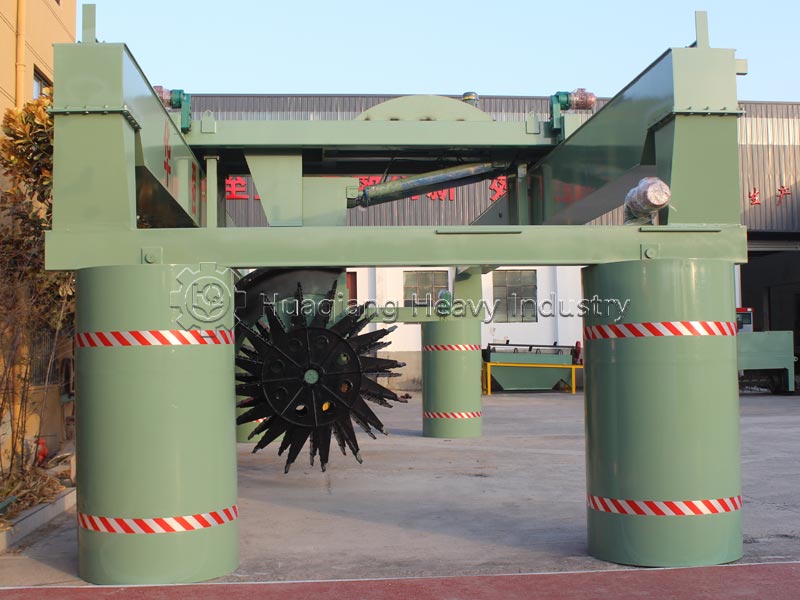
Frame: Constructed from welded structural steel, it supports all components, including the rotating disc(s), transmission system, and travel mechanism. The machine features a turning wheel assembly mounted at the front and a propulsion system at the rear; its rigid overall structure is designed for continuous operation.
Turning Wheel Assembly: The core component, consisting of a large-diameter disc and turning tines distributed around its circumference. The wheel diameter is sized according to processing capacity requirements, and the tines are made of wear-resistant steel and are detachable for replacement. It can be configured with a single or dual-wheel setup; the dual-wheel configuration offers a wider turning swath and higher efficiency.
Turning Drive System: An electric motor drives the wheel’s rotation via a gearbox and a chain or gear transmission. The system delivers high torque, ensuring stable operation even when processing high-density materials.
Propulsion Mechanism: A travel motor drives the wheels or crawler tracks, propelling the machine forward along the windrow. Travel speed is adjustable and coordinated with the wheel rotation speed to control turning depth and efficiency.
Lifting/Adjustment Mechanism: Hydraulic cylinders or screw jacks adjust the wheel’s height above the ground, controlling the depth to which the tines penetrate the material. The wheel is raised during relocation or shutdown to prevent the tine tips from remaining in prolonged contact with the ground.
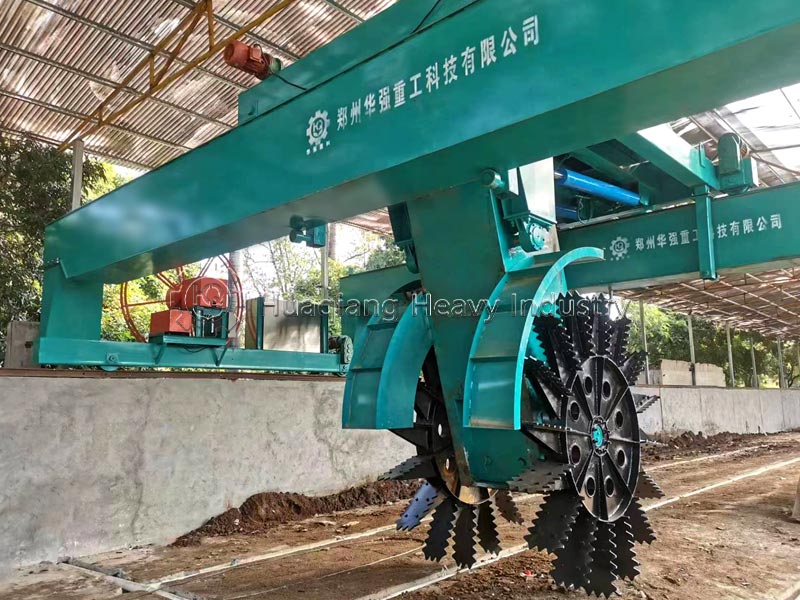
Deep Turning Capability: The large-diameter wheel reaches the bottom of the windrow, offering greater turning depth than standard equipment; it thoroughly turns over the bottom layer, preventing the formation of anaerobic zones caused by long-term accumulation.
Effective Material Break-up: As the wheel rotates, the tines scoop up and throw the material at high speed. This disperses the material thoroughly in the air, breaking up clumps and tearing apart long fibers, resulting in a loose, aerated product.
Ample Oxygen Supply and Rapid Temperature Rise: The material makes full contact with air during the turning process. Aerobic microorganisms receive sufficient oxygen for vigorous metabolic activity, rapidly raising the windrow temperature above 50°C. This high temperature is sustained for an extended period, ensuring the thorough inactivation of pathogens and weed seeds.
High Moisture Evaporation Efficiency: Throwing the material into the air maximizes its contact area with the atmosphere, accelerating the evaporation of excess moisture. For fresh manure with high moisture content, just a few turning passes can reduce moisture levels to the optimal range for fermentation, eliminating the need to add large quantities of dry material.
Flexible and agile operation: The equipment can self-propel along the length of the material piles, eliminating the need for laying rails or constructing fixed fermentation tanks. Windrow composting sites allow for flexible adjustments to pile locations and orientations, making it easy to relocate the equipment.
Wide processing capacity range: By adjusting travel speed and wheel rotation speed, a single machine can adapt to varying turning frequencies and throughput requirements; operational frequency can be increased during peak fermentation seasons to meet production demands.
Livestock and poultry manure: Manure from chickens, pigs, sheep, cattle, ducks, and other livestock. The large-wheel turner’s deep turning capability and powerful breaking action make it suitable for processing materials prone to clumping, such as pig manure, and fibrous materials like cattle manure.
Agricultural waste: Straw powder, rice husk powder, corn cobs, peanut shells, sugarcane bagasse, etc. Long-stalk materials do not require excessive pre-shredding, as the tearing action of the turning wheel’s teeth effectively breaks up fibers.
Landscaping waste: Shredded branches, fallen leaves, grass clippings, trimmings, etc. These materials are bulky but loose in texture; the large wheel compost turner offers high processing efficiency due to its wide turning swath.
Kitchen and household organic waste: Source-separated kitchen waste, fruit and vegetable scraps, etc. After preliminary shredding, these are mixed with field-crop materials for composting, with the large wheel compost turning machine handling daily turning and aeration.
Industrial organic waste: Sugar mill filter mud, distillery grains, vinegar residue, traditional Chinese medicine dregs, cassava residue, etc. Industrial wastes vary significantly in moisture content and viscosity; the powerful throwing action of the turning wheel helps regulate moisture and break up viscous materials.
| Model | Main Motor | Small Car Moving Motor | Big Car Moving Motor | Hydraulic Pump Motor |
| LP-10m | 55KW | 1.5KWX4 | 1.5KWX2(4) | 4KW |
| LP-12m | ||||
| LP-15m | ||||
| LP-20m |