Composting is an important way to utilize organic waste resources and a core part of organic fertilizer production lines. However, if raw materials carry pesticide residues, whether they can decompose in compost depends on factors such as the type of pesticide, the composting environment, and equipment control.
The composting environment is crucial for decomposition, and organic fertilizer compost turning machines can precisely control this environment. Microbial communities are active in compost. Turning machines maintain an aerobic environment and ensure a high temperature of 55-65℃ for several weeks through regular turning, aiding microbial metabolism and decomposition of some pesticides. Simultaneously, the turning machine can adjust the uniformity of the material, optimizing organic matter and pH conditions in conjunction with the production line’s process parameters, thus improving decomposition efficiency. In the absence of oxygen, not only is decomposition inhibited, but toxic intermediate products may also be produced.
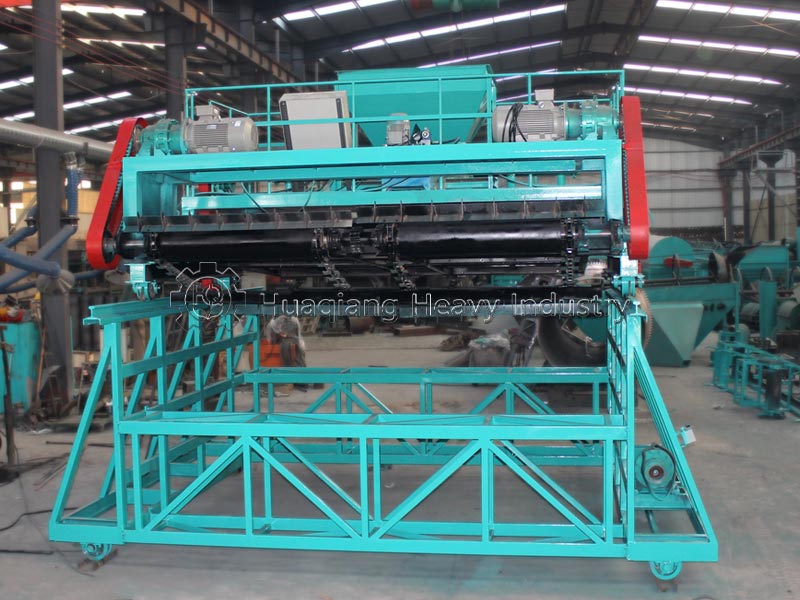
The type of pesticide determines the ease of decomposition. Organophosphates and pyrethroids, which are easily degradable, can be broken down into harmless substances by microorganisms under the suitable environment controlled by a compost turner, posing a low risk of residue. Organochlorines and other persistent pesticides, however, are structurally stable, heat-resistant, and resistant to degradation, making them difficult to completely decompose and prone to long-term residue.
Furthermore, high concentrations of residue can inhibit microbial activity and reduce the decomposition rate. Pesticides with prolonged residue time form stable bound states, making them even more difficult to degrade. This also places demands on the raw material testing process in organic fertilizer production lines.
It is recommended that organic fertilizer production lines prioritize the use of residue-free raw materials. If there are concerns about the raw materials, extending the high-temperature turning time and enhancing the aerobic environment through a compost turning machine can improve the degradation effect. Raw materials containing persistent pesticide residues must be strictly prohibited from being fed into the system to prevent the spread of contamination.