Is the chain-plate compost turner rarely used as equipment for organic fertilizer production lines? The answer is not a simple “yes” or “no.” To be precise, while it may not be the most common piece of equipment in such lines, it is certainly not rare; rather, its specific applications and operational contexts are distinct.
If you visit small-to-medium-sized organic fertilizer plants, you will indeed rarely see chain-plate compost turners. These facilities, which typically process standard livestock manure, often face space constraints and budget sensitivities; they tend to favor trough-type compost turners or self-propelled compost turners—the former being low-cost and the latter offering flexible mobility. Chain-plate systems, with their complex structures and high maintenance costs, are often deemed “not cost-effective” in these settings and are consequently ruled out.
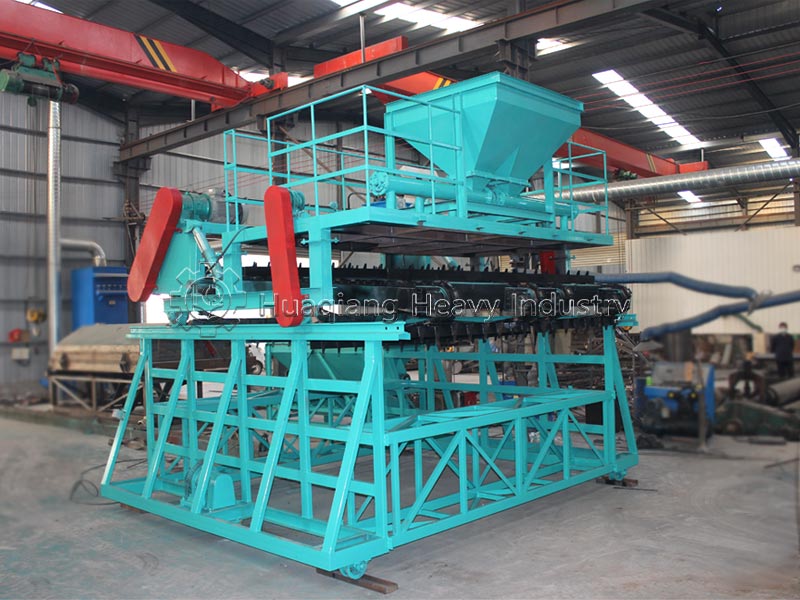
However, the situation is entirely different in large-scale organic fertilizer production lines. Especially when handling high-viscosity materials—such as municipal sludge, chicken manure, vermicompost, or pharmaceutical residues—the chain-plate compost turner becomes a preferred choice. It uses a large-surface-area chain plate to slowly push and move materials rather than cutting them with high-speed blades; this effectively prevents material from sticking to and wrapping around the shaft while preserving the material’s granular structure. In deep-trough continuous fermentation systems, it works in tandem with automated feeding and discharging equipment to facilitate the quantitative, daily forward movement of material, enabling a streamlined, assembly-line-style operation.
Scale is another critical factor. Chain-plate compost turners require supporting rails and a paved, hardened site, resulting in higher initial investment costs. Yet, when daily processing volumes reach hundreds of cubic meters, the cost per ton of material actually decreases, and the advantages of the machine’s stability and low failure rate become significant. Conversely, for small-scale, intermittent production, the investment payback period for a chain-plate system would be excessively long.
Therefore, it is inaccurate to say that chain-plate compost turners are “rarely used in organic fertilizer production lines“; rather, they are rarely used in lines characterized by small scales, low budgets, and standard materials. In scenarios involving large-scale operations, high-viscosity materials, continuous processing, and stringent quality requirements, this type of turner is, in fact, irreplaceable.