In fertilizer processing, the choice of mixer directly affects the mixing effect and production efficiency. Double axis paddle mixers differ fundamentally from ordinary fertilizer mixers in core aspects.
The core difference lies in the fact that ordinary single-shaft and ribbon mixers mostly perform unidirectional mixing, with gentle force and dead zones, making them only suitable for dry, single-component fertilizer raw materials. Double axis paddle mixers, on the other hand, employ a bidirectional staggered blade design, with the two shafts rotating in opposite directions to generate strong shearing force, thoroughly breaking up dead zones and achieving uniform mixing.
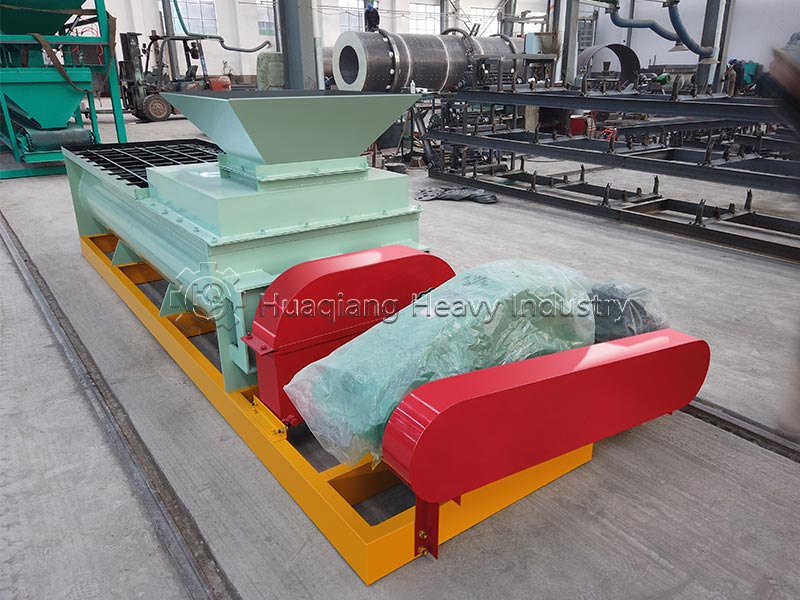
Mixing effect and suitable materials: Ordinary mixers are suitable for dry, single-component raw materials, but the mixing uniformity is limited; double shaft paddle mixers can handle high-humidity, multi-component, and agglomerated raw materials, breaking up clumps and achieving deep integration of materials with auxiliary materials and binders.
Operating efficiency and flexibility also differ: Ordinary mixers are mostly intermittently operated, with limited processing capacity; double shaft paddle mixers can achieve continuous operation, are suitable for large-scale production, and their speed and mixing time can be flexibly adjusted.
In summary, the core difference between a double axis paddle mixer and a regular fertilizer mixer machine lies in the mixing principle, making it more suitable for complex and large-scale fertilizer processing scenarios.