NPK compound fertilizer production demands stringent requirements for raw material mixing uniformity and process stability. The pre-mixing process directly impacts the nutrient balance, molding rate, and pass rate of the finished product. Double shaft paddle mixers, with their unique structural design and mixing principle, are highly compatible with continuous NPK fertilizer production lines, effectively solving problems such as uneven mixing, material stratification, and insufficient capacity associated with traditional equipment. This makes them a core component of the compound fertilizer batching process.
The unique twin-shaft staggered mixing structure adapts to the multi-raw material ratio requirements of NPK. Compound fertilizer production requires mixing nitrogen, phosphorus, and potassium base raw materials, as well as various trace additives, with material forms ranging from powder to fine particles. The equipment utilizes bidirectional convection and shear diffusion mixing methods to rapidly integrate various raw materials, eliminating material stratification, preventing uneven nutrient distribution in the finished product, and precisely ensuring the ratio standards and quality stability of the compound fertilizer.
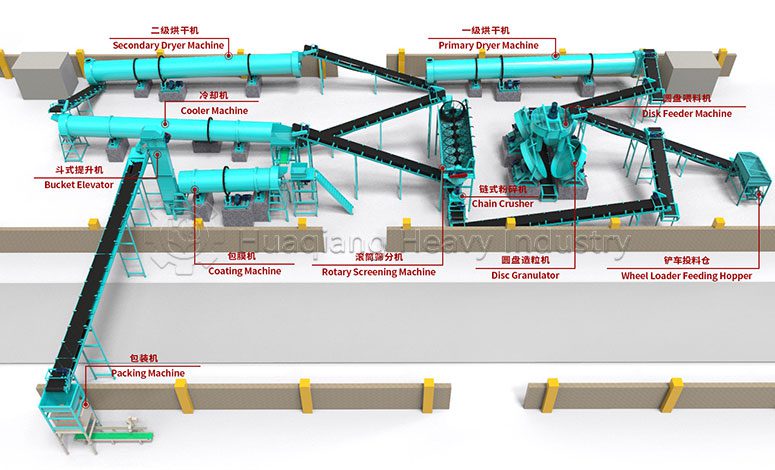
This equipment is perfectly adapted to the continuous operation rhythm of the production line, enabling uninterrupted feeding, uniform mixing, and stable discharge. It seamlessly connects to subsequent processes such as granulation, drying, and screening, eliminating problems such as material accumulation and supply interruptions. Its dead-angle-free mixing mode significantly shortens raw material pretreatment time, effectively improving the operational efficiency and capacity of the entire NPK fertilizer production line.
Simultaneously, the equipment boasts strong adaptability to various operating conditions, breaking up slight agglomerates in raw materials. Combined with its enclosed structure, it effectively reduces powder dust, optimizing the production environment. The equipment operates stably with low wear and tear, adapting to high-frequency continuous operation on the production line, significantly reducing maintenance costs and product defect rates, and helping NPK compound fertilizer production lines achieve standardized, low-cost, and high-quality mass production.