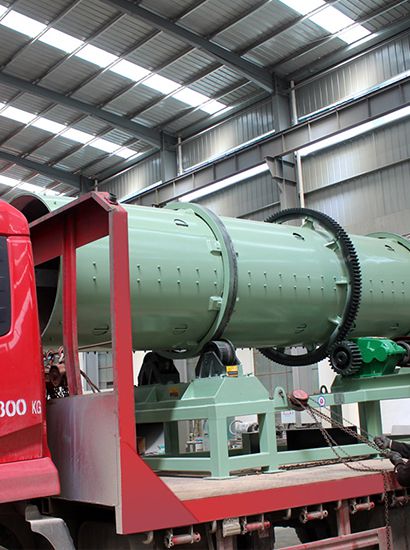
While the disc granulator is often viewed as the “star” of a production line, its ability to consistently produce uniform granules is largely dictated by the seemingly modest organic fertilizer compost turning machine used in the preceding stage. Disc granulation requires the incoming material to meet three key criteria: stable moisture content, uniform particle fineness, and the absence of long, tangled fibers.
Stable moisture content is achieved through the homogenization capabilities of the compost turner. Disc granulation is highly sensitive to moisture fluctuations—excess moisture leads to material sticking to the disc and forming clumps, while insufficient moisture causes a sharp drop in granulation yield. Trough-type compost turning machines, which operate within fixed channels with preset turning depths and travel speeds, offer significantly more stable moisture levels in the processed material compared to self-propelled models.
Uniform fineness is ensured by the controlled shearing action of the turner. Disc granulation requires material with an optimal degree of fineness; particles that are too coarse result in a rough surface, while those that are too fine lack the necessary structural framework. A cutter-roller type turner equipped with a variable-frequency drive allows for reduced rotational speed during the final stages of fermentation—breaking up clumps without over-pulverizing the material—thereby ensuring the particle size falls perfectly within the ideal range for disc granulation.
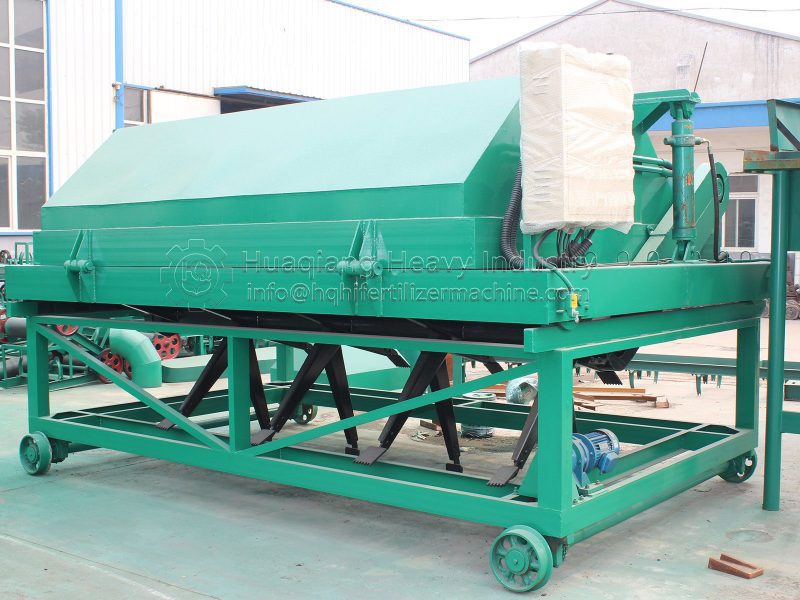
The absence of long fibers is managed by the cutting capacity of the turner. If fibrous additives, such as straw, are not cut before entering the disc, they tend to tangle into “matted balls” inside the granulator. Cutter-roller turners provide a degree of fiber-cutting action during the turning process; when combined with an initial shredding stage, this effectively keeps fiber lengths within an acceptable range.
The method of movement also influences compatibility. For large-scale production lines utilizing fixed channels, trough-type turners align better with the continuous operational rhythm of a disc granulator. For small-to-medium-scale operations with multiple windrows, self-propelled, crawler-mounted cutter-roller turners offer greater flexibility, though their consistency in turning depth is generally lower than that of channel-type systems.
Ultimately, the logic behind the synergy between a disc granulator and a compost turner is this: the turner is responsible for “conditioning” the material into a state that is optimal for the granulator, allowing the latter to perform reliably and consistently.