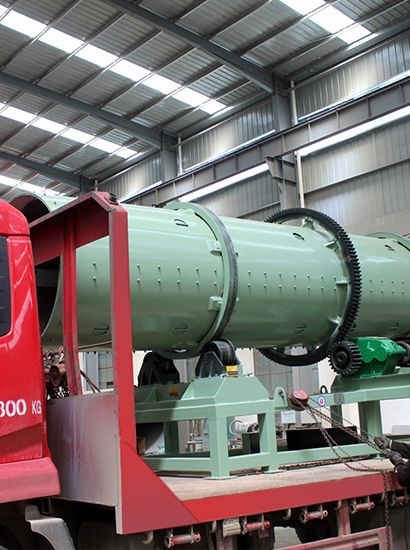
Disc granulators are demanding regarding raw materials: moisture content must be moderate, particle size uniform, and the material free of long fibers or wet sludge clumps. These characteristics are determined during the fermentation and turning stage; the choice of turner directly impacts the granulation rate and the volume of material requiring reprocessing.
Disc granulation favors material that is fine, uniform, and loose. Material that is too coarse resists agglomeration; material that is too wet sticks to the disc; and long fibers tangle around the disc rim. Therefore, an organic fertilizer compost turner must do more than just supply oxygen—it must break up clumps and refine the material during the turning process.
Prioritize drum-type turners (equipped with cutting blades). Whether using a trough-type or a self-propelled crawler model, the right drum configuration applies shear force during turning to break hard clumps, resulting in more uniform output particle size. Models with variable frequency drives offer flexibility: high speeds early on accelerate temperature rise, while lower speeds later prevent over-pulverization, allowing for precise control over fineness. For highly sticky materials, choose a drum with self-cleaning, staggered teeth to prevent clogging and equipment shutdowns.
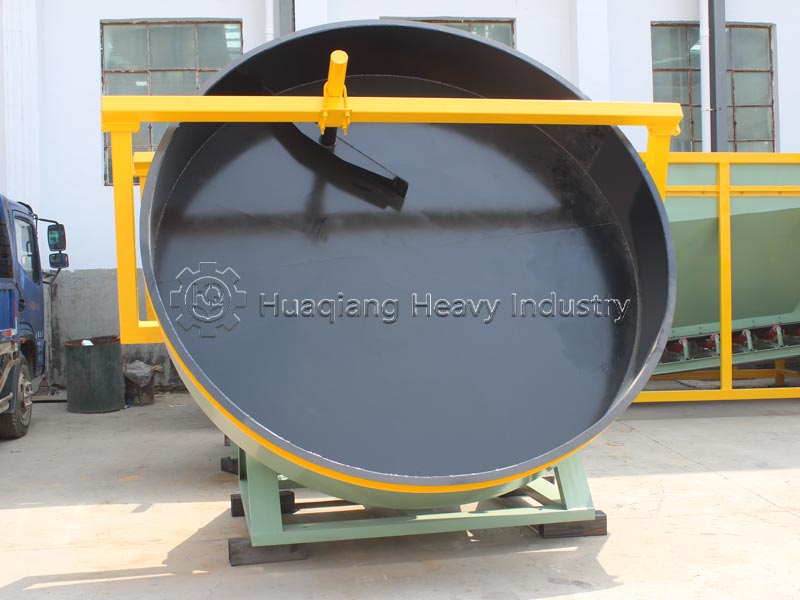
Chain-plate turners are not the first choice. While their gentle pushing action preserves fiber length—benefiting fermentation—long fibers can easily tangle around the disc granulator rim, reducing the granulation rate. If a chain-plate turner is already in use, an additional pulverization step becomes necessary, increasing costs.
Scale dictates the choice of mobility. For large-scale lines with fixed troughs, trough-type drum turners offer stable efficiency and low electricity costs; for small-to-medium operations or sites with variable layouts, self-propelled crawler models offer greater flexibility. If the feedstock consists primarily of high-viscosity materials like chicken manure or sludge, prioritize drum designs that feature anti-sticking mechanisms.
Ultimately, the core logic behind selecting a turner for a disc granulation production line is that turning serves not only fermentation but also material preparation for granulation. Choosing a drum-type machine capable of moderate material refinement during turning is often more cost-effective than simply prioritizing raw turning speed. When the material condition is right, disc granulation proceeds smoothly.