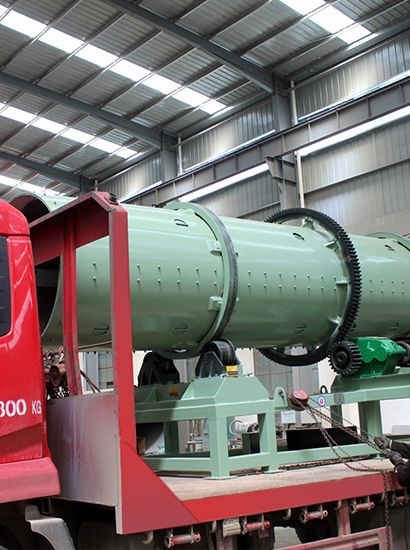
In organic fertilizer production process, double shaft paddle mixers and horizontal ribbon mixers are frequently compared. Choosing the right one can double efficiency, whereas the wrong choice leads to poor mixing uniformity or excessive energy consumption.
The core of a horizontal ribbon mixer consists of one or two helical ribbons wrapped around a central shaft; as they rotate, they drive the material to move axially and radially along the vessel walls, creating an overall circulation pattern. This process causes minimal damage to particle shapes, making it ideal for loose granules or fine powders while ensuring high mixing uniformity. However, the ribbon’s thrust is limited; if the material’s moisture content exceeds 20% or contains sticky components, material tends to adhere to the ribbon surfaces, causing efficiency to plummet. Consequently, the loading coefficient is typically kept between 60% and 70%.
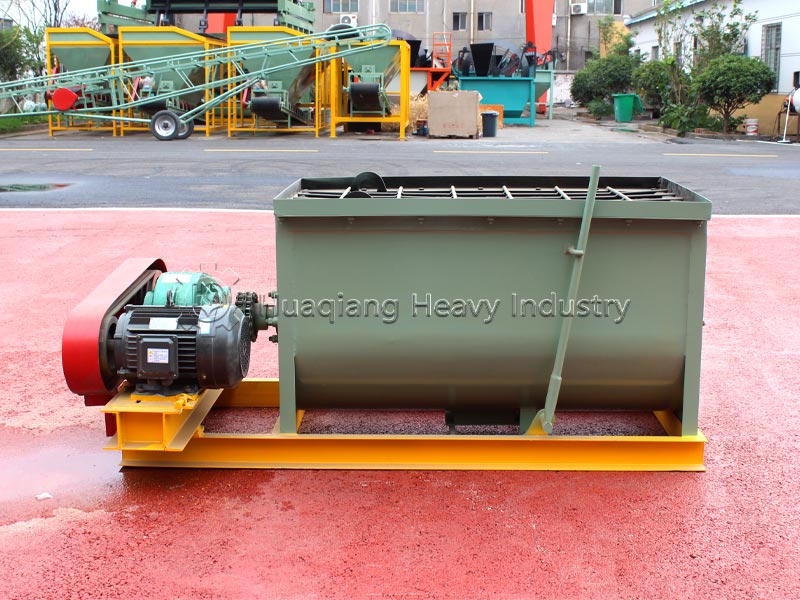
In contrast, the double shaft paddle mixer features sets of paddles mounted on two parallel shafts that rotate in opposite directions, creating an overlapping mixing zone. It cuts through the material at high linear speeds, offering exceptional adaptability to sticky or wet materials—even handling sludge-like mixtures with around 30% moisture content efficiently. It supports a higher loading coefficient of 80%–90%, resulting in greater production capacity. The trade-off is that it tends to crush particles, and its power consumption is 20%–30% higher than that of the ribbon type.
Their process roles differ: ribbon mixers are suited for the gentle mixing of finished products or the blending of trace elements, whereas double shaft paddle mixers are commonly used for raw material pretreatment—vigorously kneading decomposed organic matter with inorganic nutrients to prepare the mixture for granulation.
Regarding maintenance, the ribbon mixer features a simple structure that is easy to service, while the double shaft paddle mixer demands high installation precision and requires more labor-intensive paddle replacement.
In summary: choose the ribbon mixer for loose, dry materials, and the double shaft mixer for sticky, wet, or difficult materials—understanding the material’s state is more important than simply focusing on equipment specifications.